

- Describe your company in one paragraph.
Random Red is an R&D-driven SME focused on privacy-preserving data infrastructures and advanced digital technologies, combining expertise in AI/ML, IoT systems, cybersecurity, and cryptographic computation (including Fully Homomorphic Encryption – FHE). The company develops secure-by-design solutions for data-intensive environments where confidentiality, interoperability, and compliance are critical, with a strong focus on digital metrology and data spaces. Random Red actively contributes to European innovation ecosystems (e.g. AIQI, IDSA, IMEKO, EUROLAB) and has a proven track record in EU-funded projects such as TruPS.eu and MorphMetro.eu, delivering architectures that bridge research and application. Its approach integrates edge intelligence, cloud services, and privacy-enhancing technologies to enable trustworthy digital transformation across sectors.
- What challenge are you addressing under the O-CEI Horizon’s first Open Call, and how is your proposal relevant to the challenge?
HyFHE-Net addresses O-CEI Challenge P1C5, which requires innovative Edge-AI solutions for real-time energy management under strict constraints of privacy, latency, and limited edge resources. The core challenge lies in enabling advanced analytics on highly sensitive smart meter data while maintaining compliance with data protection requirements and ensuring operational feasibility on constrained devices.
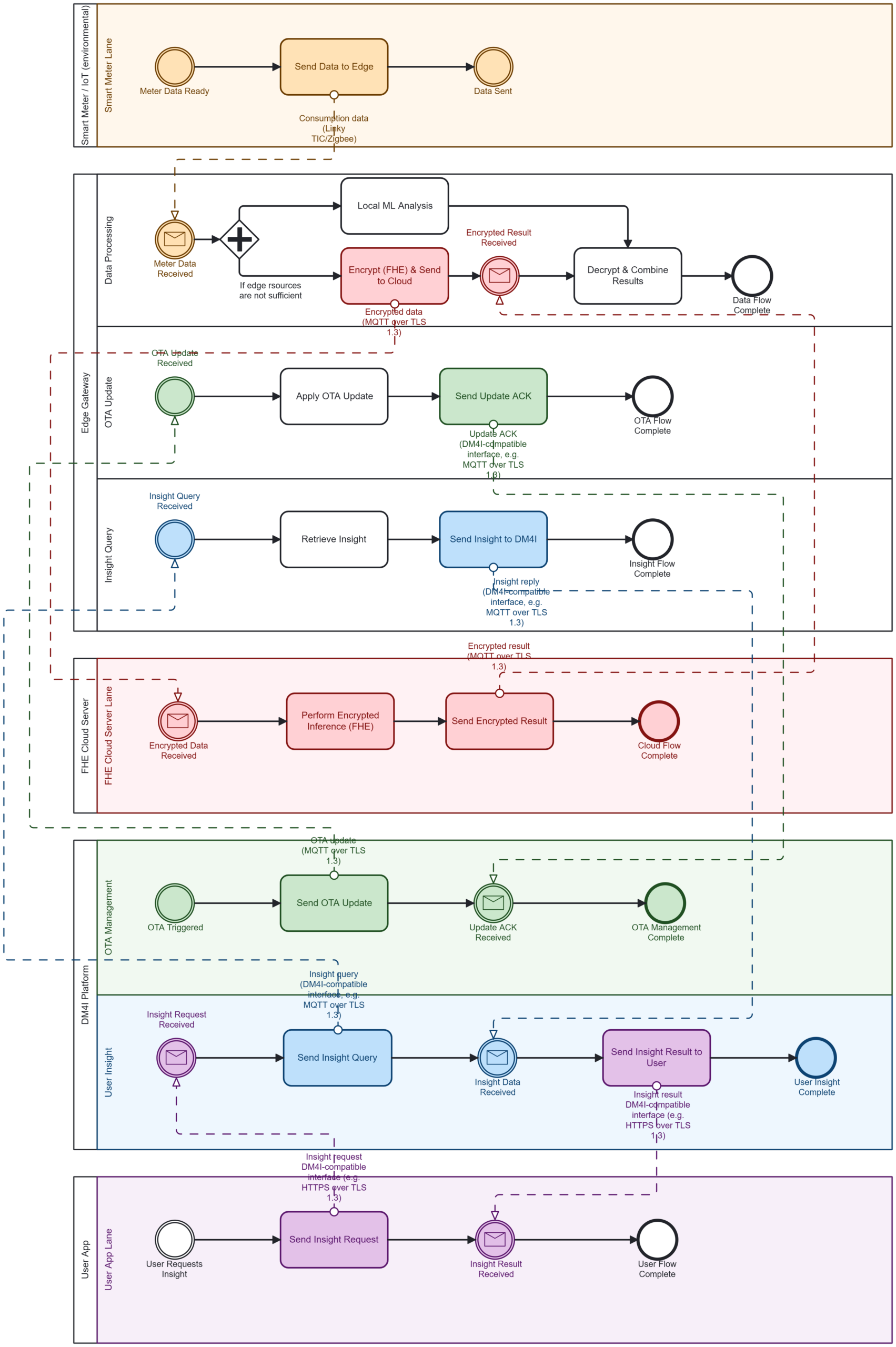
Current approaches present a structural trade-off: cloud-based AI enables advanced analytics but compromises privacy, while edge-only solutions preserve privacy but lack computational capacity for complex models. HyFHE-Net resolves this by introducing a hybrid Edge–Cloud AI architecture where lightweight, latency-critical models run locally, while computationally intensive analytics are offloaded to the cloud under Fully Homomorphic Encryption (FHE), ensuring that data remains encrypted throughout processing.
This approach is directly aligned with the challenge objectives:
- Real-time decision-making is ensured through edge-resident AI modules.
- Advanced analytics are enabled via encrypted cloud computation.
- Privacy-by-design is guaranteed, as no raw data leaves the household.
- Interoperability is ensured through seamless integration with EDF’s DM4I platform and compliance with the sensor and device ecosystem used in Pilot 1.2 (e.g. Linky smart meters, Zigbee-based IoT devices), enabling alignment with existing CEI infrastructure.
The proposal is therefore highly relevant as it not only addresses the technical constraints of Edge-AI in energy systems but also resolves the fundamental privacy barrier that currently limits large-scale adoption of data-driven energy services. It contributes a deployable TRL 6-7 pilot solution that supports Pilot 1.2 scenarios and establishes a new paradigm for secure, distributed intelligence in energy infrastructure.
- What is the expected impact of your proposal?
HyFHE-Net is expected to deliver impact at technical, market, and societal levels, addressing a structural gap in the energy ecosystem: enabling AI-driven services without compromising user privacy.
From a technical perspective, the project demonstrates, for the first time in a residential energy context, the feasibility of encrypted AI inference using FHE. It introduces a novel hybrid architecture and workload-partitioning methodology that optimizes the distribution of intelligence between edge and cloud based on latency, resource constraints, and privacy requirements. This establishes a reusable reference model for privacy-preserving Edge-AI systems beyond the energy sector.
From a market perspective, HyFHE-Net unlocks new business opportunities for utilities, DSOs, and technology providers by enabling high-value services such as load forecasting, demand response optimization, and appliance-level analytics without exposing sensitive consumption data. This directly addresses a key adoption barrier in Europe, where privacy concerns and regulatory constraints limit the exploitation of smart meter data. The solution’s open and modular architecture supports rapid adoption and scalability across EU markets, contributing to the digitalization of the energy sector.
From a societal and environmental perspective, the project supports the European Green Deal by enabling more efficient energy consumption, increased participation in demand-response programs, and better integration of renewable energy sources. At the same time, it strengthens citizen trust by ensuring full data confidentiality and compliance with GDPR principles, reinforcing Europe’s leadership in human-centric digital innovation.
Overall, HyFHE-Net delivers a high-impact, scalable solution that bridges the gap between advanced analytics and data sovereignty, positioning Europe at the forefront of privacy-preserving AI in critical infrastructure.