


ADR Forum 2026, Porto, Portugal

Loading Events

EVENT

ADR Forum 2026, Porto, Portugal

DETAILS

Date & Time: 

October 13 - October 14

Event organiser: 

Event website: 

SUMMARY

O-CEI Pilot 6 Presented at “Beyond the Pilot: How European Robotics Reaches Certified Industrial Deployment”

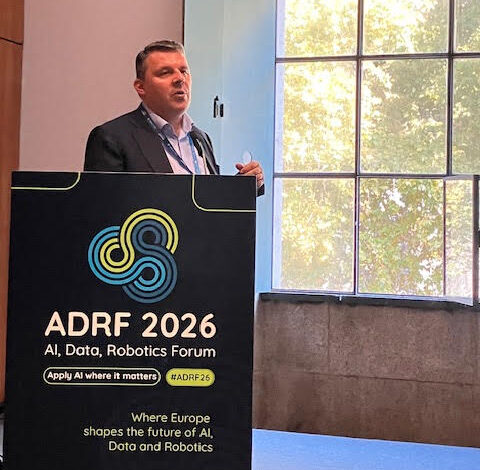
O-CEI Pilot 6 was presented as the agricultural robotics case study in the workshop “Beyond the Pilot: How European Robotics Reaches Certified Industrial Deployment”, held at ADR Forum 2026 in Porto on 13 October. Alongside AMALTEA and euROBIN, it provided a practical example for examining why promising robotics demonstrators can stall before reaching certified, trusted and commercially viable deployment.

Focusing on electric robot tractors in kiwi plantations in the Basque Country, the presentation described how the ZETRABOT prototype combines environmental sensing, real-time data integration, AI-supported route and task planning, and predictive battery management. The pilot’s three scenarios address energy-efficient field operations, planning within constrained orchard layouts, and smart recharging, with farmer oversight retained. Its edge-enabled approach addresses an important agricultural constraint: cloud connectivity cannot always be assumed, so essential local operation and safe behaviour must be considered alongside cloud-supported optimisation.

The central contribution to the workshop was the distinction between a functioning prototype and a deployable product. Pilot 6 illustrated the assurance challenge of bringing together the physical machine, updateable AI and software services, cybersecurity, field-validation evidence and human oversight within a coherent safety case. A key question for discussion was how responsibility should be allocated when the tractor, AI services, battery services and farm data come from different providers—and how changes to software or models should be managed without undermining the system’s assessed safety.

The case also connected technical validation with adoption and long-term exploitation. It highlighted the potential role of agricultural Testing and Experimentation Facilities in generating repeatable evidence under realistic conditions, and of European Digital Innovation Hubs in supporting farmer training, integration, business-case assessment and replication. These issues fed into the workshop’s participatory mapping of barriers along the journey from pilot and testing to certification, first customer and scale, positioning Pilot 6 as a concrete example of the need to connect field performance with clear accountability, reusable validation evidence and a sustainable ownership and maintenance model.
Advanced Microturbines

Can you briefly introduce your company and what you do?

Advanced Microturbines Srl is an Italian deep-tech SME specialised in the development of compact microturbine technologies for energy recovery and self-powered monitoring systems. The company designs and manufactures high-efficiency microturbines from 50 W to 50 kW capable of converting pressure drops in gas and water networks into electricity, enabling autonomous power supply for IoT sensors and digital infrastructure. Its solutions support the digitalisation and sustainability of energy and industrial systems by transforming unused pressure energy into a reliable source of power for remote monitoring applications. By combining microturbine technology with smart IoT systems, we deliver innovative solutions that support smart infrastructure, improve energy efficiency, and enable decentralised energy systems.

What challenge are you addressing under the O-CEI Horizon’s first Open Call, and how is your proposal relevant to the challenge?

Our proposal addresses the challenge of enabling transparent, secure, and real-time management of energy flows in decentralised energy systems, particularly in emerging smart microgrids. As renewable generation becomes increasingly distributed, local energy communities require reliable mechanisms to measure, validate, and share energy data between multiple actors. However, current infrastructures often rely on centralised systems, not distributed ones.

The ENTRUST solution tackles this challenge by developing an edge-validated blockchain platform for energy transactions. The system integrates IoT metering, edge computing, and blockchain notarisation to create a distributed architecture capable of securely validating energy data close to where it is generated. This approach enables real-time, low-latency processing while ensuring data integrity and transparency through blockchain mechanisms.

By combining edge processing with blockchain-based verification, the proposed platform allows microgrid participants, including households, local producers, and community operators, to securely record and validate energy exchanges. This contributes directly to the goals of the O-CEI Horizon’s Open Call by supporting decentralised, trustworthy, and scalable digital infrastructures for energy communities and smart grids.

What is the expected impact of your proposal?

The expected impact of the proposal is the development of a secure and transparent operational layer for decentralised energy systems, enabling more efficient management of renewable energy within local microgrids.

Through the integration of IoT metering, edge computing, and blockchain notarisation, the ENTRUST platform allows energy transactions and operational data to be securely recorded, validated, and shared in real time. This improves transparency and trust among microgrid participants while ensuring the integrity of energy data used for operational decisions and potential energy trading mechanisms.

The project will demonstrate the solution in the Krk Island pilot, showing how local communities can manage renewable energy generation and consumption more effectively. By enabling tamper-proof data validation and automated smart-contract processes, the platform supports fair and auditable energy exchanges between producers, consumers, and community operators.

Beyond the pilot, the modular and scalable architecture of ENTRUST allows the platform to be replicated in other energy communities and distributed energy systems across Europe. In this way, the project contributes to the broader objectives of the European energy transition, supporting the integration of renewable energy, strengthening local energy resilience, and enabling new models of transparent and decentralised energy management aligned with EU climate and energy policies.

Company website: www.microturbines.it