
This article was initially published in French in the Bulletin.ch
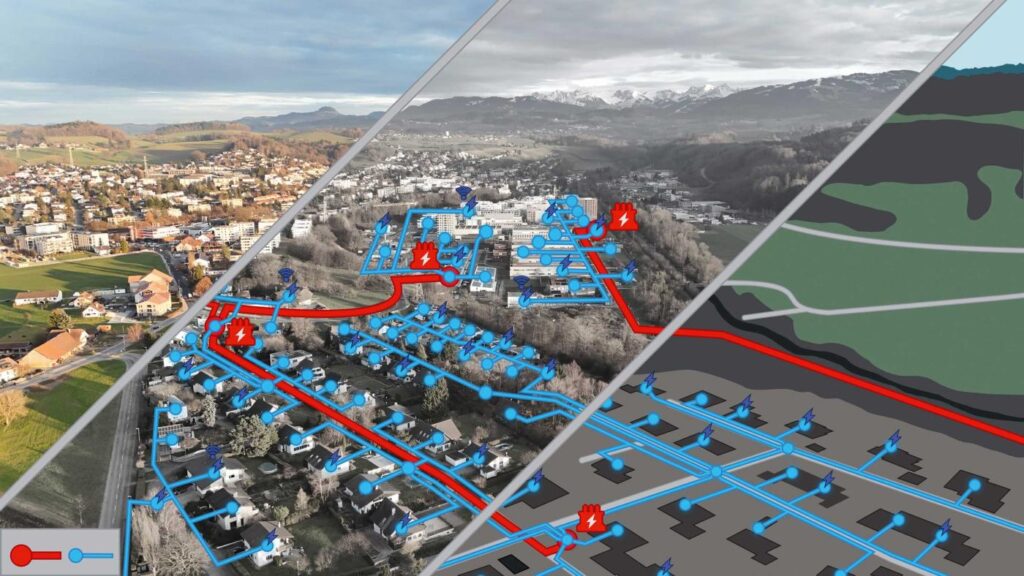
The three districts of the Fribourg site with the low and medium-voltage networks. | Figure: HEIG-VD/HEIA-FR (HES-SO)
Dr. Emmanuel Fragnière, Dr. Nabil Abdennadher, Raoul Dupuis, Pascal Kienast
The Swiss electricity grid is evolving rapidly, as current buildings demonstrate. In a building equipped with heat pumps and electric vehicles, the evening consumption peak is no longer the same as it was ten years ago: meal preparation, laundry, charging the electric vehicle, and restarting the heat pump can occur simultaneously. Two floors up, a simple variation in photovoltaic production, for example, a passing cloud, is enough to make the power injected into the grid drop back down in a few minutes. These are not theoretical scenarios, but recurring situations for grid managers, who are observing more frequent local congestion and an increasing need to resort to redispatching, a rebalancing between production and consumption, to stabilize the system.
These tensions do not mean that the system is collapsing, but that it needs finer and more local management. Today, the question is no longer whether to intervene, but how to do it without complicating the lives of users. Concretely, this means anticipating a peak in consumption and/or production before it becomes a problem, shifting a charge by a few minutes, or sequencing a startup to avoid a coincidence of loads. In other words, it is a matter of making the grid more supple and flexible, without asking residents to become technicians or operators to adopt tools that are too heavy.
This is where the following idea comes into play: equipping neighborhoods with local intelligence, with reliable measurements at the periphery of the grid, human preferences truly taken into account, and a neighborhood digital twin capable of testing several options before acting. This approach transforms technical adjustments into simple, readable, and acceptable decisions. And it is precisely this pragmatic vision, anchored in reality, that has guided two complementary projects: LASAGNE, which laid the foundations of the modern microgrid, and O-CEI, which is deploying this intelligence at the scale of neighborhoods and real sites in 11 European countries, including Switzerland.
The LASAGNE Project: The Grammar of the Modern Microgrid
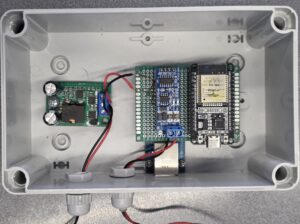
The European project LASAGNE (Digital framework for smart grid and renewable energies) was conducted from 2022 to 2025. Co-funded by the SFOE (Swiss Federal Office of Energy), it was coordinated by the University of Applied Sciences and Arts Western Switzerland (HES-SO) and carried out in collaboration with the University of Geneva, Clemap (a Zurich-based company specializing in the measurement and control of energy infrastructures), as well as with Swedish partners KTH, Tvinn, and Electricity. The project aimed to create a complete digital framework for smart grids, based on grid edge devices (Grid Edge Devices, GED) capable of finely measuring usage and supporting local energy services through collaborative algorithms.
On the technical level, the project developed four essential elements: GED devices, digital twins to represent the different energy roles of a neighborhood, predictive algorithms that estimate electrical energy consumption, and a decentralized coordination model allowing for the avoidance of any single point of failure. The whole was designed by integrating a social acceptance approach for this new type of smart technology so that the management choices remain understandable and acceptable for the inhabitants.
On the conceptual level, this project defined what we call the “grammar of the modern microgrid”: a simple but robust structure that guides the way a neighborhood can produce, consume, predict, and decide locally. This grammar is based on three principles:
- Measuring precisely to capture the reality of usage;
- Explaining simply so that the management rules are readable;
- Deciding locally by letting digital twins orchestrate gentle adjustments that relieve the grid without disrupting users.
By laying these technical and social foundations, the LASAGNE project prepared the ground for the logical next step: the transition to scale and operational status, embodied today by the O-CEI project and its Swiss pilot.
The O-CEI Project
O-CEI (Open Cloud-Edge-IoT Platform Uptake in Large Scale Cross-Domain Pilots) is a Horizon Europe project (2025–2028) designed to move digital solutions from the prototype stage to large-scale deployment. It orchestrates a Cloud-Edge-IoT platform capable of managing data, models, and decisions consistently between the building, the neighborhood, and an IT infrastructure in the cloud. The project relies on eight pilot sites, deployed across 10 countries. Multi-sectoral, these cover smart grids, electromobility, agriculture, logistics, and urban environments.
In Switzerland, the HES-SO supervises a pilot entitled “Strengthening citizen engagement and acceptance of energy flexibility in urban neighborhoods,” in which five Swiss partners are involved: HES-SO, Clemap, the Polygones housing cooperative in Geneva, the municipality of Val d’Anniviers, and the energy supply company Groupe E. The pilot is deployed on three contrasting sites—Polygones (in Geneva), the site composed of the Bel-Air district, the eco-district of the Ancienne Papeterie, and the MIC Business Park (in Fribourg), and tourist infrastructures in Val d’Anniviers, to observe, under real conditions, how users and the grid react to local flexibility and smart management strategies. Together, these sites illustrate exactly what a microgrid service must produce: anticipating a peak in consumption or production, smoothing a power call, and making usage rules readable, without turning residents into engineers or operators into network operators.
On the conceptual level, O-CEI is a regional and European scale extension of the LASAGNE project: where the latter defined the grammar of the microgrid locally, measuring finely thanks to Clemap’s GEDs, representing actors via digital twins, predicting future consumption, and coordinating without a single point of failure; O-CEI provides the distributed infrastructure allowing several buildings, electric vehicle charging stations, and ski lifts to cooperate, for example in Val d’Anniviers. The Cloud-Edge-IoT platform allows for the sharing of models, the dynamic execution of decisions, and the synchronization of flexibility between heterogeneous sites, while respecting strict requirements for confidentiality, security, and performance.
And above all, built on the experience of the LASAGNE project, Switzerland brings a distinctive competence to O-CEI: that of social acceptance applied to microgrids. The Swiss pilot thus becomes a pioneering laboratory in which engineering, real uses, and the preferences of inhabitants are integrated into the same decision loop. LASAGNE allowed for the building of the foundations, O-CEI is currently deploying the solution on a large scale, and Switzerland is showing, within the framework of this European project, that microgrids can work concretely with the support of the inhabitants.
Why Is This Crucial for the Future?
With the increasing electrification of heat production and mobility, low-voltage power calls (heat pumps, electric vehicles, evening cooking) are increasing and concentrating over a few hours. Physically strengthening all sections of the grid would be long and costly. This is what is called the “copper approach.” It is more realistic to spread demand where it appears, by shifting or sequencing certain local uses without disrupting comfort. This vision is commonly referred to as the “smart approach.”
At the same time, the variability of photovoltaic energy shifts the constraints: voltage disturbances can appear in neighborhoods where no one expected them, simply because a passing cloud abruptly changes production. In these situations, a rapid and targeted intervention at the neighborhood level is often enough to stabilize the whole before a local incident becomes a systemic problem.
Resorting to redispatching is useful but expensive, and never treats the cause. It is more efficient and more rational to resolve imbalances where they occur (that is, in the neighborhoods themselves) before they propagate toward medium or high voltage.
Finally, none of these solutions will last over time if users do not find their way through them. The more technical or complex the interfaces, the greater the decrease in acceptance. This is why local solutions must remain readable: a few simple landmarks (produce, consume, save), two modes of use (comfort or economy), and a comprehensible sharing rule are enough. It is this simplicity that guarantees that local flexibility will actually be adopted.
What Does the System Actually Do?
To understand concretely how a next-generation microgrid works, one must rely on the data provided daily by GED sensors. Measurements carried out in the three sites of the Swiss pilot—the Meyrin cooperative, the Fribourg site, and the Val d’Anniviers site (a hotel, a high-altitude restaurant, electric vehicle charging stations, and ski lifts)—reveal an energy reality that is very different depending on the location. In a mountain hotel, for example, consumption curves indicate very marked rhythms: kitchen peaks, rooms in rapid transition, sauna or spa at regular times, and electric vehicle charging more concentrated on certain days (Figure 1). These are not models, but real uses, and it is from these uses that the system begins to work.
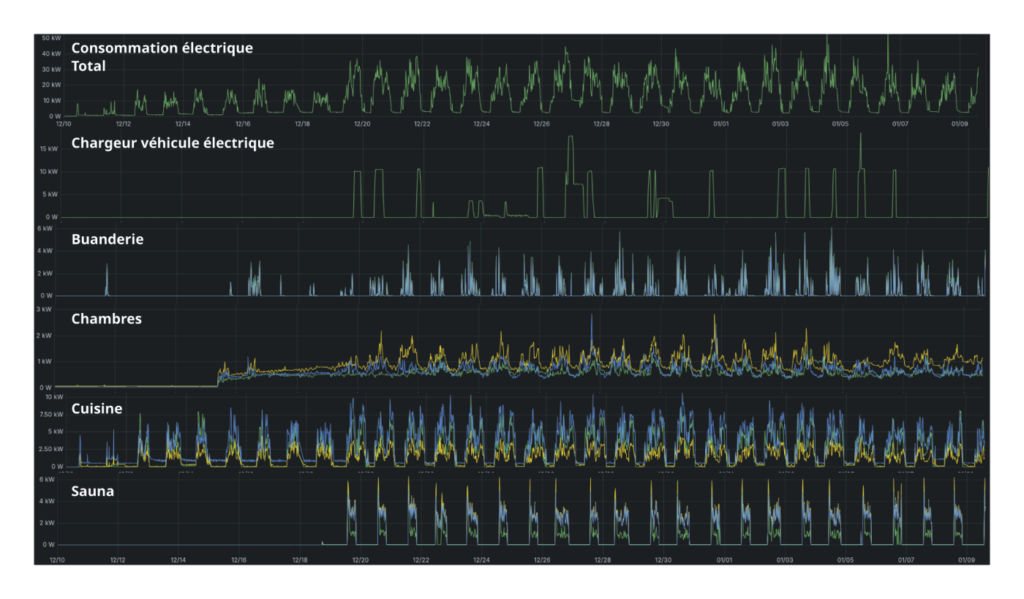
Figure 1 Measuring in the right place: these consumption curves of a mountain hotel over one month, from December 10 to January 9, highlight the different consumption rhythms of various types of loads. | Figure: HES-SO
Once these data are measured, the digital twin analyzes what is likely to happen in the following minutes or hours. It does not seek to make a perfect prediction, but to anticipate enough to avoid a coincidence of power calls. If a peak begins to take shape, it can, for example, shift a charge by a few minutes, sequence two startups that are too close, or distribute the power over a slightly longer duration. The goal is not to change habits, but to discreetly adjust what can be, without disrupting the lives of residents or the operation of a hotel. Thus, the system can adjust uses gently while maintaining a clear and equitable management logic for all households.
This ensemble relies on an observation loop associating measurements, human preferences, and simulations. At Polygones, several scenarios were proposed to the inhabitants (Figure 2): which appliances can have their consumption shifted, for how long, and under what conditions? In schools, measurements reveal short but very regular peaks, which allows for minimal sequencing without disrupting the organization of activities. In Val d’Anniviers, seasonal variations and tourist crowds create a much more irregular energy profile: fine data allow for the adjustment of instructions throughout the day. In each of the three sites, the same logic applies: measure, listen, simulate, apply gently, and learn for the future. It is this loop that transforms a technical concept into a stable and understandable service.
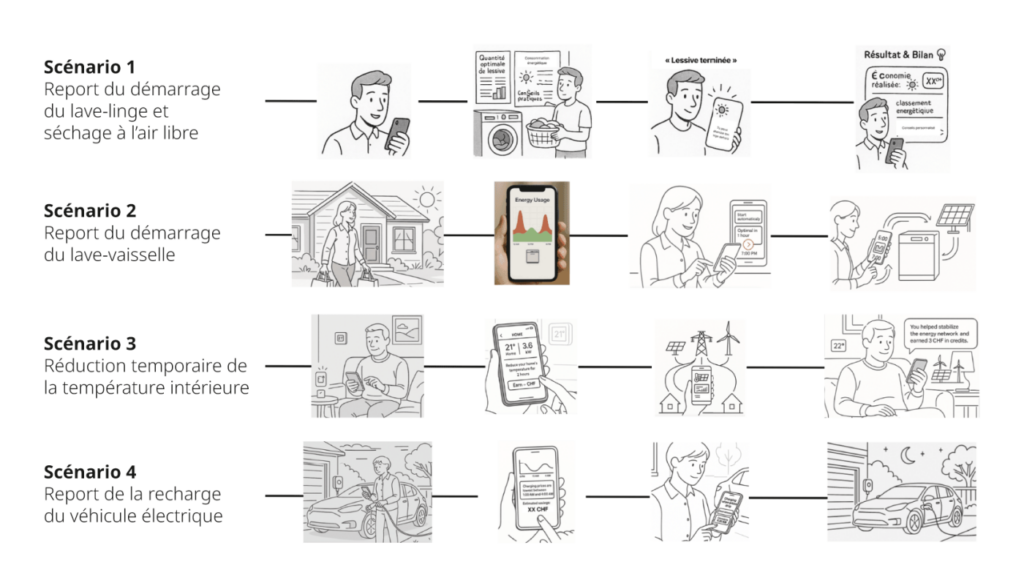
Figure 2 Usage scenarios proposed to inhabitants for the evaluation of social acceptance. | Figure: HES-SO
Figure 3 allows for the visualization of how these blocks fit together. It presents the architecture of the Swiss pilot, with Clemap’s GED sensors (Edge AI) performing local measurements, digital twins representing the various actors in the neighborhood, and the Cloud-Edge-IoT orchestration that links buildings, uses, and decisions. This figure clearly shows that the microgrid is not an opaque object: it is a coherent system in which each layer fulfills a precise role. The GED serves to protect privacy and react quickly, the cloud aggregates and compares scenarios in order to improve models, and the digital twins test the selected adaptations before taking action, so that local decisions remain gentle and accepted.
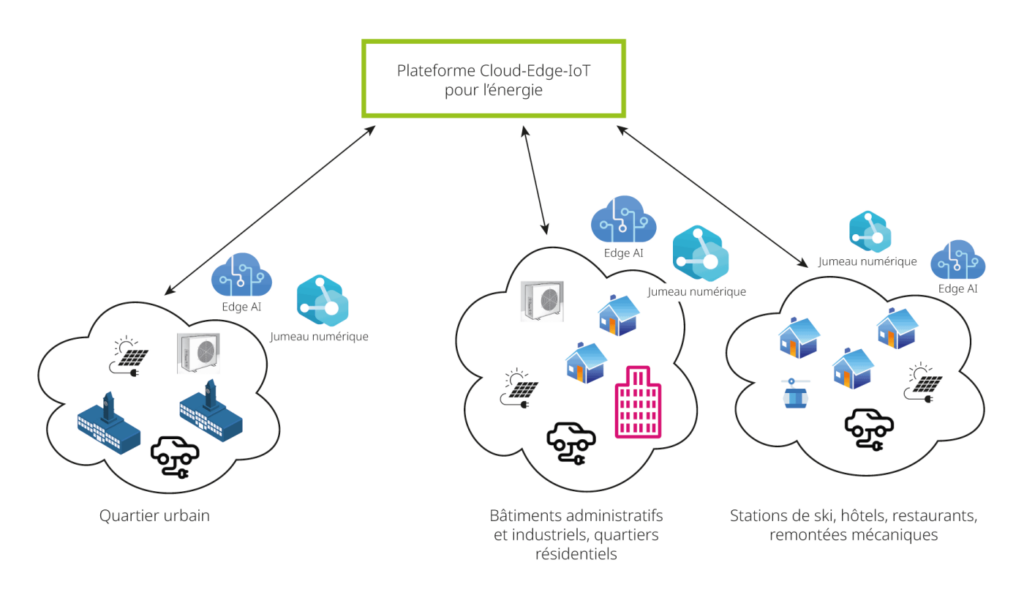
Figure 3 A simple, open architecture ready for large-scale extension thanks to the interlocking of various technical blocks: GED sensors (Edge AI) for local data, digital twins, social experiments for scenarios, and the Cloud-Edge-IoT platform for orchestration. | Figure: HES-SO
By combining these three dimensions—fine measurements, social scenarios, and digital twins—the microgrid becomes a true local energy service. It is thus understandable why this approach makes it possible to reduce trial and error, inform choices, and make decisions that respect the grid, operators, and residents alike. In short, it is a technology that does not impose, but accompanies and provides evidence before asking for support.
The Augmented Grid, Service Side
The era of smart microgrids has arrived: sensors measure reality, digital twins anticipate just enough, GED devices react near people, and social sciences guarantee support. The result is not a gadget, but a readable, equitable, data-sober local energy service that smooths peaks and values solar energy without disrupting usage. This “augmented grid” imposes nothing; it accompanies, proves, and then learns at each loop. This is how reliability, controlled costs, and shared trust are gained. And if everything goes well, the only alarm that will sound will be that of the coffee machine, just long enough for a ristretto, once the peak load has passed.