
BDVA Data Week

Loading Events

EVENT

BDVA Data Week

DETAILS

Date & Time

May 27 @ 2:00 pm - 3:30 pm

Event organiser

BDVA and SEMIC

Website:

Event website

SUMMARY

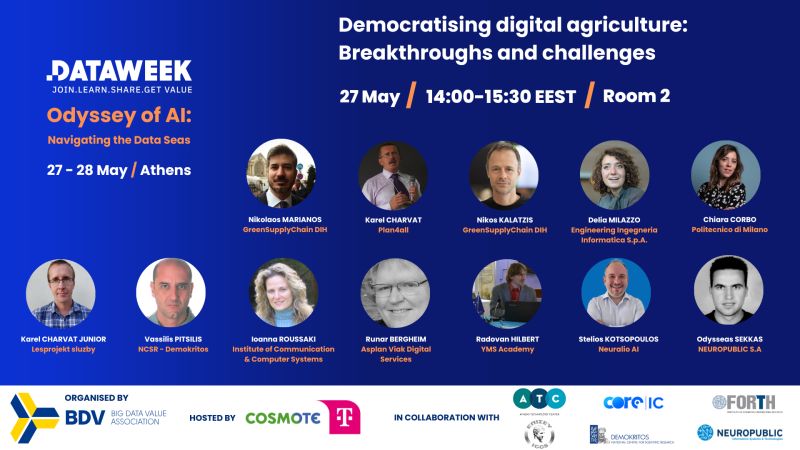
On May 27th, our partners from National Center for Scientific Research “Demokritos” (NCSRD) and GreenSupplyChain DIH (GSC) will take part in the Data Week 2025 session titled “Democratising digital agriculture: Breakthroughs and challenges.”

GSC is the organizer of the session and the included panel on “CloudEdgeIoT Continuum, Data interoperability and Open-Source software”. It will guide the overall discussion for all presented projects and guide the discussion to help NCSRD present the impact of O-CEI in agriculture.

NCSRD will join the panel on behalf of the O-CEI project and deliver a presentation titled “Continuum technologies for optimising energy consumption in sustainable dairy production.” The focus of the presentation will be on the specific challenges that O-CEI is trying to address, to empower key industries, including the agriculture and livestock sector, to optimize resource usage, reduce environmental impact, and drive Europe’s transition to a greener, more efficient energy landscape.

O-CEI is creating an open, collaborative CEI platform that enables sectors to securely exchange digital assets, including services and AI-based solutions. It emphasizes interoperability, trust, and data governance to ensure collaboration under clear rules and safeguards. Flexible deployment practices simplify the rollout and scaling of digital tools across diverse environments, from the cloud to the edge, supporting real-world needs.

The National Center for Scientific Research “Demokritos” (NCSRD) is Greece’s largest multidisciplinary research centre, consisting of five independent institutes. It employs around 180 tenured and tenure-track researchers, along with over 500 research staff working on projects funded by national programmes, the European Union, and private industry. Within the O-CEI project, the FRONT Research Group of NCSRD acts as the Scientific Leader, ensuring the strategic alignment of research activities while overseeing the quality of deliverables and the overall scientific progress of the project.

GreenSupplyChain DIH (GSC) is a Digital Innovation Hub based in both Greece and the Netherlands. Its mission is to support the digital transformation of all stakeholders—large and small—within the agri-food supply chain, helping them bridge the “digital divide.” In the O-CEI project, GSC leads Task 4.6 on “Sustainable dairy extensive production processes” and Pilot 5 on “Energetically and environmentally sustainable Halloumi cheese production.”
Advanced Microturbines

Can you briefly introduce your company and what you do?

Advanced Microturbines Srl is an Italian deep-tech SME specialised in the development of compact microturbine technologies for energy recovery and self-powered monitoring systems. The company designs and manufactures high-efficiency microturbines from 50 W to 50 kW capable of converting pressure drops in gas and water networks into electricity, enabling autonomous power supply for IoT sensors and digital infrastructure. Its solutions support the digitalisation and sustainability of energy and industrial systems by transforming unused pressure energy into a reliable source of power for remote monitoring applications. By combining microturbine technology with smart IoT systems, we deliver innovative solutions that support smart infrastructure, improve energy efficiency, and enable decentralised energy systems.

What challenge are you addressing under the O-CEI Horizon’s first Open Call, and how is your proposal relevant to the challenge?

Our proposal addresses the challenge of enabling transparent, secure, and real-time management of energy flows in decentralised energy systems, particularly in emerging smart microgrids. As renewable generation becomes increasingly distributed, local energy communities require reliable mechanisms to measure, validate, and share energy data between multiple actors. However, current infrastructures often rely on centralised systems, not distributed ones.

The ENTRUST solution tackles this challenge by developing an edge-validated blockchain platform for energy transactions. The system integrates IoT metering, edge computing, and blockchain notarisation to create a distributed architecture capable of securely validating energy data close to where it is generated. This approach enables real-time, low-latency processing while ensuring data integrity and transparency through blockchain mechanisms.

By combining edge processing with blockchain-based verification, the proposed platform allows microgrid participants, including households, local producers, and community operators, to securely record and validate energy exchanges. This contributes directly to the goals of the O-CEI Horizon’s Open Call by supporting decentralised, trustworthy, and scalable digital infrastructures for energy communities and smart grids.

What is the expected impact of your proposal?

The expected impact of the proposal is the development of a secure and transparent operational layer for decentralised energy systems, enabling more efficient management of renewable energy within local microgrids.

Through the integration of IoT metering, edge computing, and blockchain notarisation, the ENTRUST platform allows energy transactions and operational data to be securely recorded, validated, and shared in real time. This improves transparency and trust among microgrid participants while ensuring the integrity of energy data used for operational decisions and potential energy trading mechanisms.

The project will demonstrate the solution in the Krk Island pilot, showing how local communities can manage renewable energy generation and consumption more effectively. By enabling tamper-proof data validation and automated smart-contract processes, the platform supports fair and auditable energy exchanges between producers, consumers, and community operators.

Beyond the pilot, the modular and scalable architecture of ENTRUST allows the platform to be replicated in other energy communities and distributed energy systems across Europe. In this way, the project contributes to the broader objectives of the European energy transition, supporting the integration of renewable energy, strengthening local energy resilience, and enabling new models of transparent and decentralised energy management aligned with EU climate and energy policies.

Company website: www.microturbines.it