
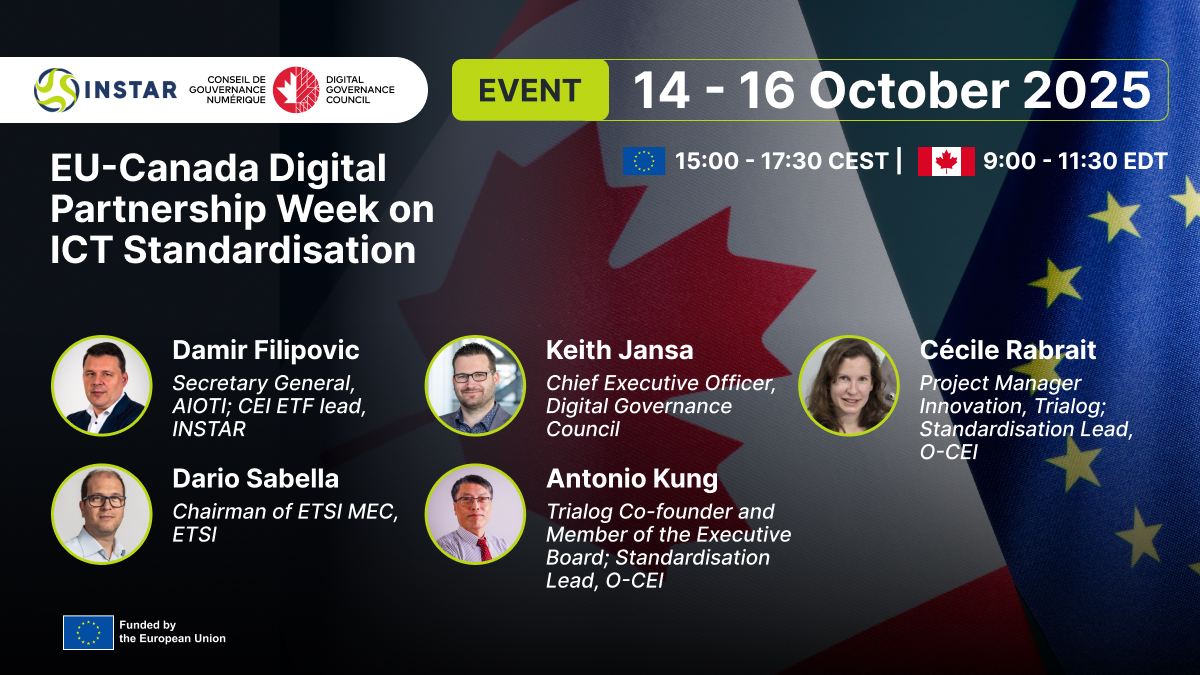
EU-Canada Digital Partnership Week on ICT Standardisation

Loading Events

EVENT

EU-Canada Digital Partnership Week on ICT Standardisation

DETAILS

Date & Time

October 14 - October 16

Event organiser

Event website

SUMMARY

O-CEI Partners Join the EU–Canada Digital Partnership Week on ICT Standardisation

Starting on 14 October 2025, O-CEI Horizon partners are participating in the EU–Canada Digital Partnership Week on ICT Standardisation, a key event bringing together policymakers, industry leaders, and standardisation experts to strengthen international cooperation on digital standards.

O-CEI plays an active role during the first day of the event, dedicated to Cloud-Edge-IoT (CEI): Building Cross-Sectoral Standardisation Interfaces — a theme central to digital innovation in mobility, energy, and manufacturing.

  • Universitat Politècnica de València (UPV), O-CEI Project Coordinator, will participate in the session “Scaling Innovation: How Large-Scale Pilots and Industry Activities Inform Standardisation.” Dr. Ignacio Lacalle Úbeda, from UPV, will present the project’s standpoint on standardisation initiatives, showcasing how O-CEI pilots can contribute content, inspiration, and materialisation towards pre-normative efforts. The large-scale nature of O-CEI pilots allows innovations to be channelled and demonstrated in real environments across multiple domains. The Hourglass Model will be used to characterise the strategy partners will follow in this regard.
  • Trialog, O-CEI’s standardisation leader, represented by Antonio Kung and Cécile Rabrait, will join the panel “Cross-Border Interoperability – Concrete Steps Towards Open CEI Standards.” They will highlight how interoperability, connectivity, security, and trust are fundamental pillars of O-CEI’s standardisation roadmap, and how the project contributes to strengthening international collaboration in the CEI domain.

Through this participation, O-CEI reinforces its commitment to advancing cross-border collaboration, fostering industrial competitiveness, and supporting the creation of trusted, interoperable digital ecosystems across Europe and beyond.

Advanced Microturbines

Can you briefly introduce your company and what you do?

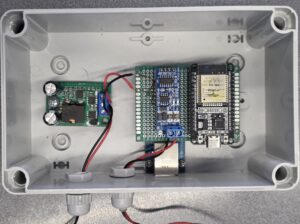
Advanced Microturbines Srl is an Italian deep-tech SME specialised in the development of compact microturbine technologies for energy recovery and self-powered monitoring systems. The company designs and manufactures high-efficiency microturbines from 50 W to 50 kW capable of converting pressure drops in gas and water networks into electricity, enabling autonomous power supply for IoT sensors and digital infrastructure. Its solutions support the digitalisation and sustainability of energy and industrial systems by transforming unused pressure energy into a reliable source of power for remote monitoring applications. By combining microturbine technology with smart IoT systems, we deliver innovative solutions that support smart infrastructure, improve energy efficiency, and enable decentralised energy systems.

What challenge are you addressing under the O-CEI Horizon’s first Open Call, and how is your proposal relevant to the challenge?

Our proposal addresses the challenge of enabling transparent, secure, and real-time management of energy flows in decentralised energy systems, particularly in emerging smart microgrids. As renewable generation becomes increasingly distributed, local energy communities require reliable mechanisms to measure, validate, and share energy data between multiple actors. However, current infrastructures often rely on centralised systems, not distributed ones.

The ENTRUST solution tackles this challenge by developing an edge-validated blockchain platform for energy transactions. The system integrates IoT metering, edge computing, and blockchain notarisation to create a distributed architecture capable of securely validating energy data close to where it is generated. This approach enables real-time, low-latency processing while ensuring data integrity and transparency through blockchain mechanisms.

By combining edge processing with blockchain-based verification, the proposed platform allows microgrid participants, including households, local producers, and community operators, to securely record and validate energy exchanges. This contributes directly to the goals of the O-CEI Horizon’s Open Call by supporting decentralised, trustworthy, and scalable digital infrastructures for energy communities and smart grids.

What is the expected impact of your proposal?

The expected impact of the proposal is the development of a secure and transparent operational layer for decentralised energy systems, enabling more efficient management of renewable energy within local microgrids.

Through the integration of IoT metering, edge computing, and blockchain notarisation, the ENTRUST platform allows energy transactions and operational data to be securely recorded, validated, and shared in real time. This improves transparency and trust among microgrid participants while ensuring the integrity of energy data used for operational decisions and potential energy trading mechanisms.

The project will demonstrate the solution in the Krk Island pilot, showing how local communities can manage renewable energy generation and consumption more effectively. By enabling tamper-proof data validation and automated smart-contract processes, the platform supports fair and auditable energy exchanges between producers, consumers, and community operators.

Beyond the pilot, the modular and scalable architecture of ENTRUST allows the platform to be replicated in other energy communities and distributed energy systems across Europe. In this way, the project contributes to the broader objectives of the European energy transition, supporting the integration of renewable energy, strengthening local energy resilience, and enabling new models of transparent and decentralised energy management aligned with EU climate and energy policies.

Company website: www.microturbines.it