

- Describe your company in one paragraph.
HiveIntel GmbH is a Berlin-based spin-out from the Technical University of Berlin founded to commercialise open-source results from the SmartEdge project. The company combines deep expertise in semantic data integration, semantic stream processing, edge intelligence and federated data systems, with hands-on experience in vehicular data from EU projects such as SmartEdge and SMARTY. HiveIntel’s team brings a rare mix of research excellence and product orientation: it has built proven edge RDF and federated streaming technologies, and is now packaging them as containerised, market-ready products and data services. The team has also received awards for semantic and AI-based solutions, including recognition in the Siemens Sustainability Challenge.
- What challenge are you addressing under the O-CEI Horizon’s first Open Call, and how is your proposal relevant to the challenge?
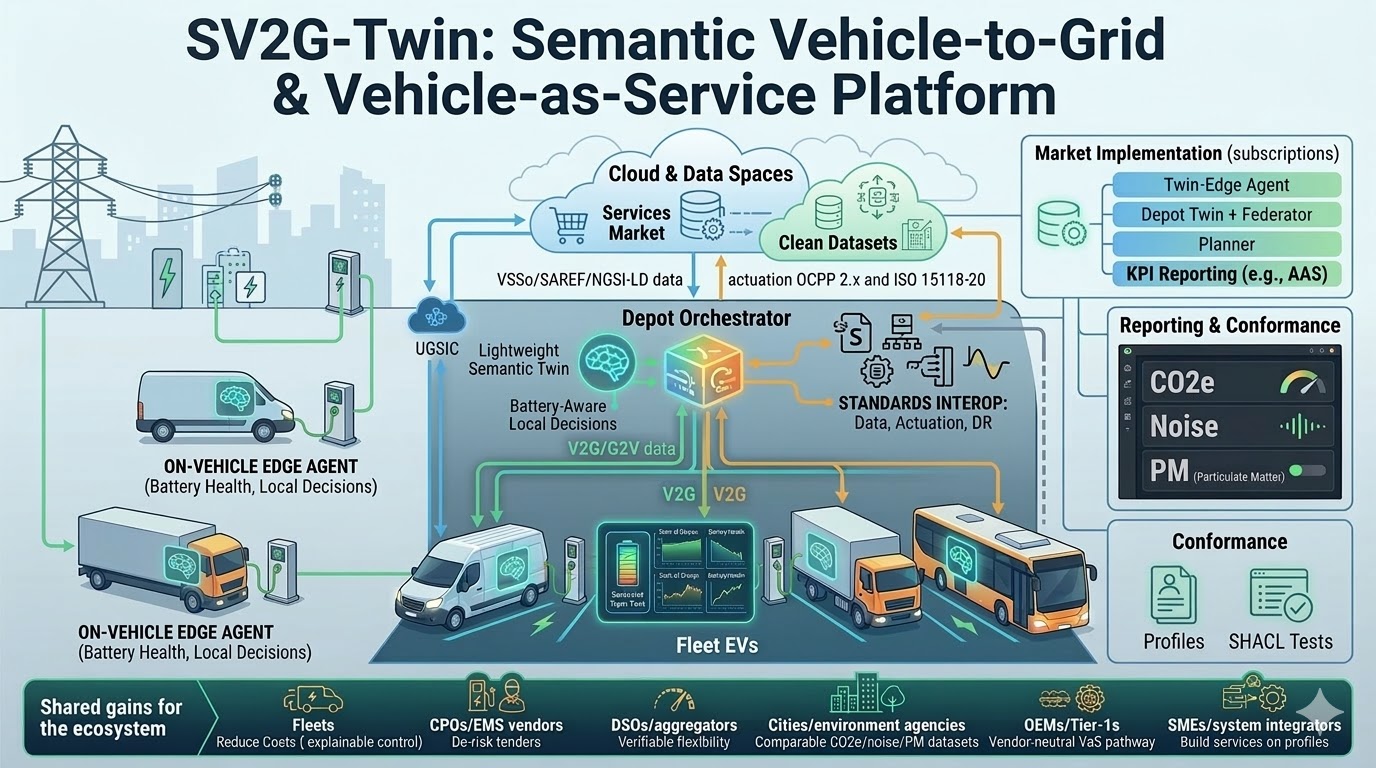
We address Pilot 2, Challenge P2C3: Vehicle as Software (VaS) for Fleet V2G Integration. This challenge asks for an open, containerised data-management solution that enables real-time Cloud–Edge–IoT monitoring and control of charging and discharging, supports battery-health-aware scheduling, integrates grid signals and demand response, and extends ISO-23795-1 to electric vehicles and/or additional pollutants so the resulting data can be shared with traffic and environment agencies. Our project, SV2G-Twin, fits this exactly. It deploys a vehicle-side edge container that reads BMS and vehicle telemetry, performs semantic stream processing and SHACL guardrail checks locally, and compiles safe charging/discharging actions into OCPP / ISO 15118-20 control paths. At depot level, a Federator + OpenADR VEN coordinates feeder constraints and demand-response events, while a cloud planner optimises cost, peak load, battery health and carbon impact. In parallel, we deliver an ISO-23795-1 EV & pollutants extension as software with JSON-LD contexts, conformance rules and dataset exporters, so Pilot 2 gets not only V2G control, but also auditable, machine-readable sustainability evidence for agencies and sustainability reporting of OCEI’s stake holders.
- What is the expected impact of your proposal?
SV2G-Twin is expected to create impact at three levels. First, operational impact for fleets and grid actors: it enables battery-safe V2G participation, peak shaving and demand-response, targeting measurable reductions in depot peaks and energy costs while maintaining low-latency, explainable control on the vehicle edge. Second, interoperability and market impact: by packaging the solution as containerised, standards-harmonised modules with profiles-as-code, it reduces integration effort, shortens onboarding for new vehicles and chargers, and makes the solution suitable for marketplace distribution and replication across EU Member States. Third, environmental and public-value impact: the project publishes agency-grade datasets on trip-level CO₂e, noise and particulate proxies through an ISO-23795-1 extension implemented as software, helping cities, agencies and CSR teams track decarbonisation progress with trusted, machine-readable evidence. In the project’s roadmap, we also position the solution for rapid replication after the pilot, scaling from the Pilot-2 lighthouse to multiple depots and countries through marketplace onboarding, partner rollout and conformance-as-a-service.