
O-CEI Horizon actively participated in the Open Community Experience (OCX) and Open Community for Research (OCR) 2026, organised by Eclipse Foundation, bringing together European projects, policymakers, industry leaders, and open-source communities to discuss the future of Europe’s digital infrastructure.
Across the two-day event, O-CEI contributed to key discussions on how open-source collaboration can accelerate innovation, strengthen interoperability, and support Europe’s ambition for a sovereign, secure, and competitive digital ecosystem.
Open Source as a Strategic Pillar for Europe’s Digital Future
On 23 April, O-CEI took part in the workshop “Open-Source Strategies for Europe’s Sovereign Digital Infrastructure – Striving for industrial European open-source platforms.” The session explored how research projects can move beyond experimentation and translate results into real-world, industry-ready solutions. A central theme of the discussion was the growing importance of open source in enabling a sovereign, interoperable, and industry-ready European digital stack, particularly across the Cloud–Edge–IoT continuum and emerging AI-driven infrastructures.
During the workshop, Rolf Riemenschneider, Head of Sector Internet of Things at the European Commission’s DG CNECT and Project Officer for both O-CEI and COP-PILOT, provided a strong policy perspective. He highlighted that Europe is entering a new phase shaped by AI, automation, and software-defined systems, where open-source ecosystems are becoming essential enablers of interoperability, modular innovation, sustainability, and skills development. His intervention emphasised that Europe’s competitiveness will depend on its ability to build programmable, interoperable infrastructures based on open architectures, while addressing key challenges such as governance, trust, and security.
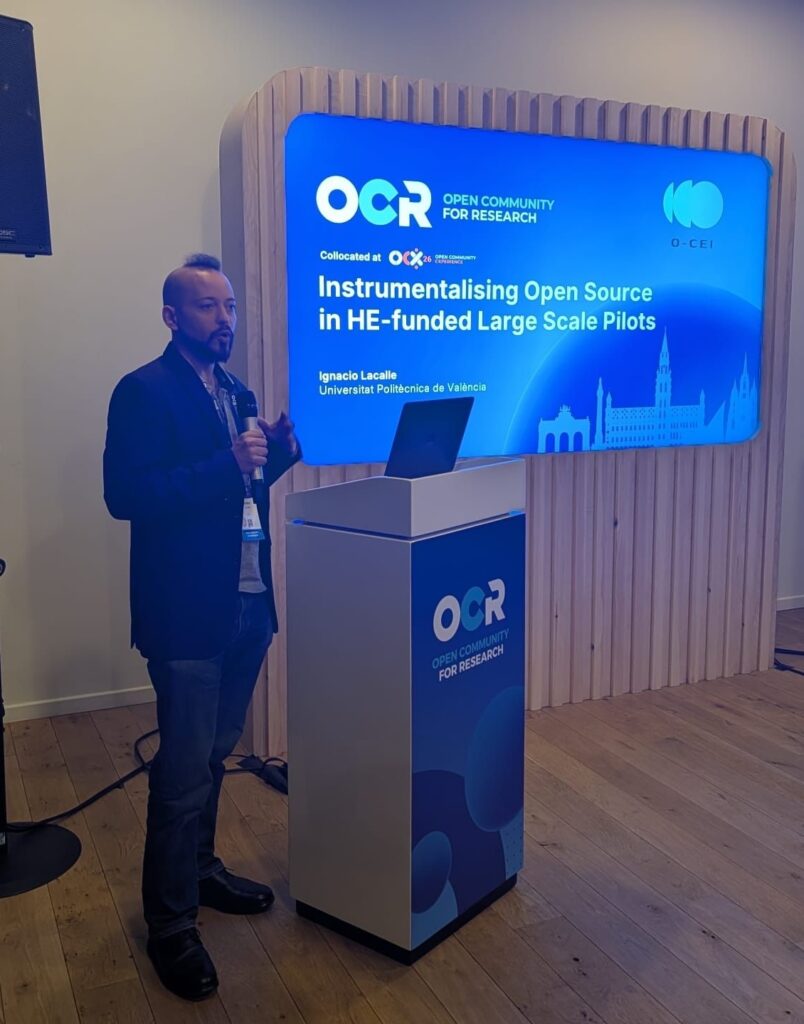
O-CEI was represented by Ignacio Lacalle Ubeda (from Universitat Politècnica de València, O-CEI coordinating partner), who presented the project’s approach to integrating open source into large-scale pilots. His intervention showcased how O-CEI combines research, industrial collaboration, and open-source development to support the creation of interoperable services across domains. The presentation introduced key O-CEI concepts, including the O-CEI marketplace, the development of blueprints, and the project’s platform as a technological backbone for the Cloud–Edge–IoT continuum. A strong emphasis was placed on making project results openly available to foster reuse, scalability, and adoption by the broader ecosystem.
Importantly, O-CEI demonstrated how embedding open-source solutions within real pilot environments (together with industrial partners such as EDF, AUMOVIO, and CMA CGM) can help reduce vendor lock-in, improve resilience, and increase trust in distributed systems. This approach reflects a broader shift towards agile, modular, and interoperable infrastructures in Europe.
The discussion further highlighted the need for stronger alignment between research, industry, and policy, particularly in a rapidly evolving landscape shaped by geopolitical considerations and increasing cybersecurity demands.
Panel Discussions: Governance, Standards, and Digital Sovereignty
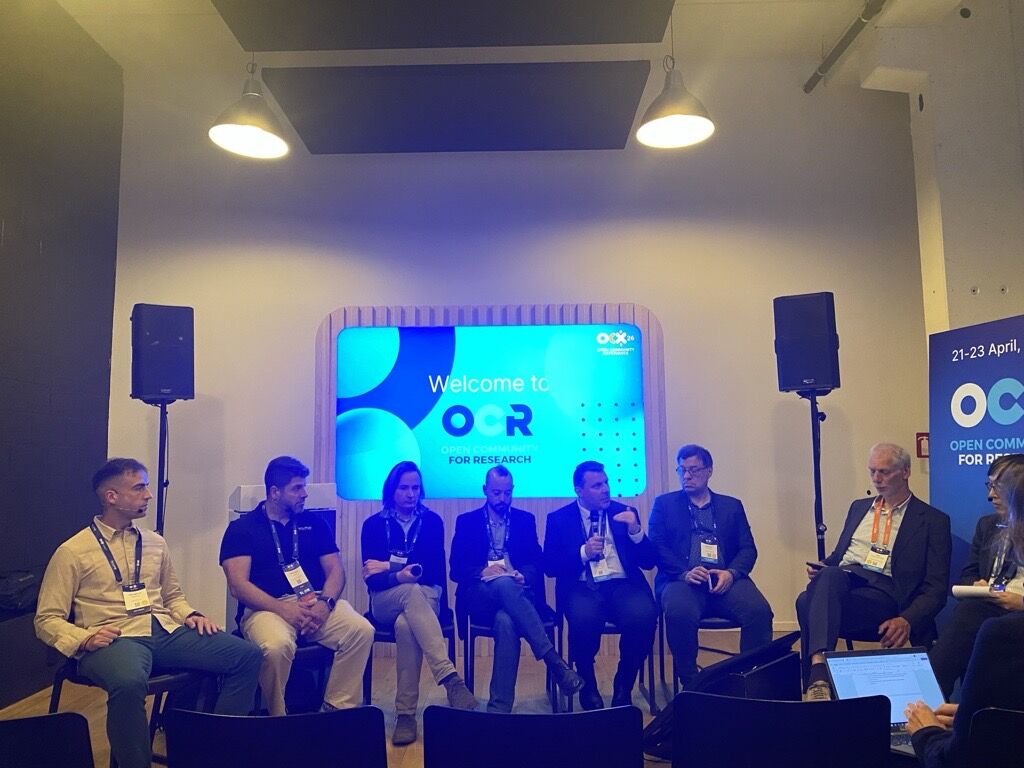
The conversations continued in a high-level panel discussion addressing one of Europe’s most pressing questions: how to build a sovereign, secure, and competitive digital infrastructure in an increasingly software-defined world.
Experts from research, industry, and policy, including representatives from O-CEI, discussed the evolving role of open source, standards, and governance. A key takeaway was that open source is no longer optional, but a strategic foundation for Europe’s digital future. However, its success depends on strong and sustainable communities, as well as effective governance models.
The panel also emphasised the need to align open-source development with standardisation efforts, particularly in areas such as cybersecurity and system integration. Bridging these gaps represents both a challenge and an opportunity to improve scalability, trust, and long-term sustainability.
Structuring Open-Source Ecosystems: The Hourglass Model
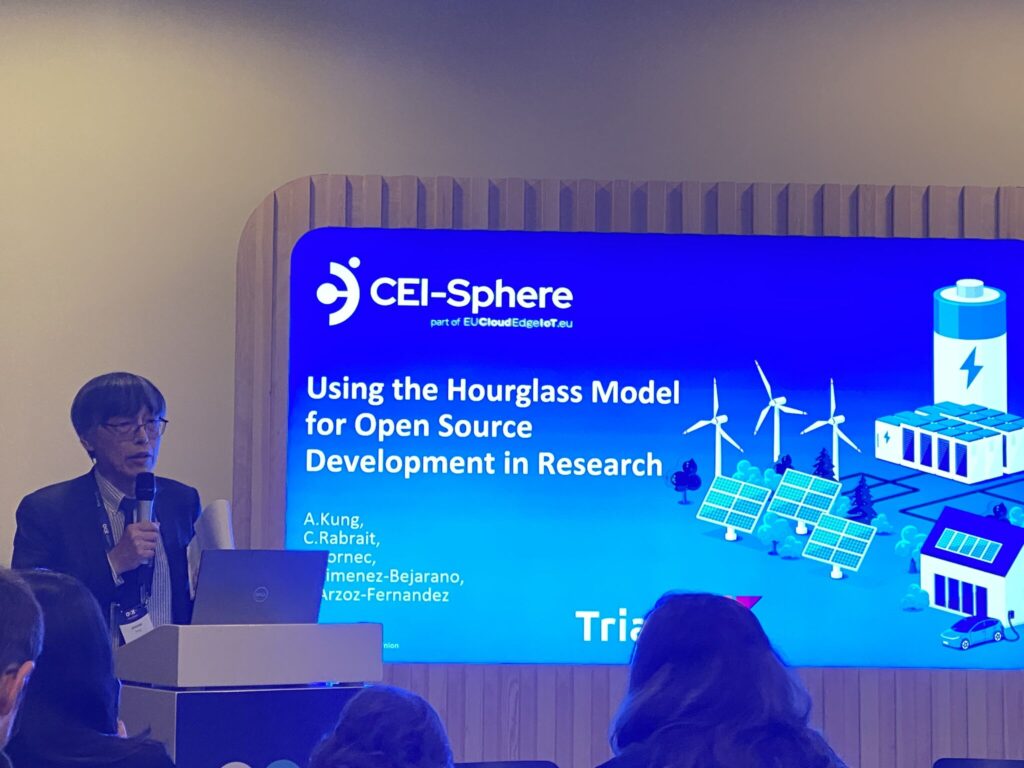
During OCX, O-CEI’s standardisation leader, Trialog, contributed to the event through a dedicated session on “Using the Hourglass Model for Open-Source Development in Research.”
Presented by Antonio Kung and colleagues, the Hourglass Model provides a structured way to map ICT ecosystems by aligning stakeholders, technologies, standards, and open-source components. The model helps projects identify where open-source solutions create the most value and how they can be reused across domains.
Applied to O-CEIand other EU-funded initiatives, the model demonstrated how projects are moving away from isolated development towards a more ecosystem-driven approach, where interoperability, standardisation, and reuse are considered from the early design phase. This is particularly relevant in Cloud–Edge–IoT environments, where fragmentation remains a key challenge.
The session also highlighted how the model supports alignment with broader European initiatives, such as CEI-Sphere and COP-PILOT, contributing to a growing, interconnected ecosystem of projects working towards a common digital infrastructure.
Building Europe’s Digital Infrastructure Together
O-CEI’s participation in OCX/OCR 2026 demonstrated the project’s commitment to advancing a federated, interoperable, and sovereign digital infrastructure for Europe. Through contributions from its partners, UPV (Project Coordinator), Eclipse Foundation (Open-Source leadership and event organizer), and Trialog (Standardisation leader), O-CEI Horizon showcased how research, open-source development, and industrial collaboration can be effectively combined.
The event reinforced a clear message: Europe’s digital future will depend on its ability to build open, interoperable, and community-driven ecosystems, supported by strong collaboration between research, industry, and policymakers. As discussions around initiatives such as EuroStack and the upcoming EU open-source strategy continue to evolve, O-CEI remains at the forefront of efforts to translate these principles into concrete solutions across the Cloud–Edge–IoT continuum.