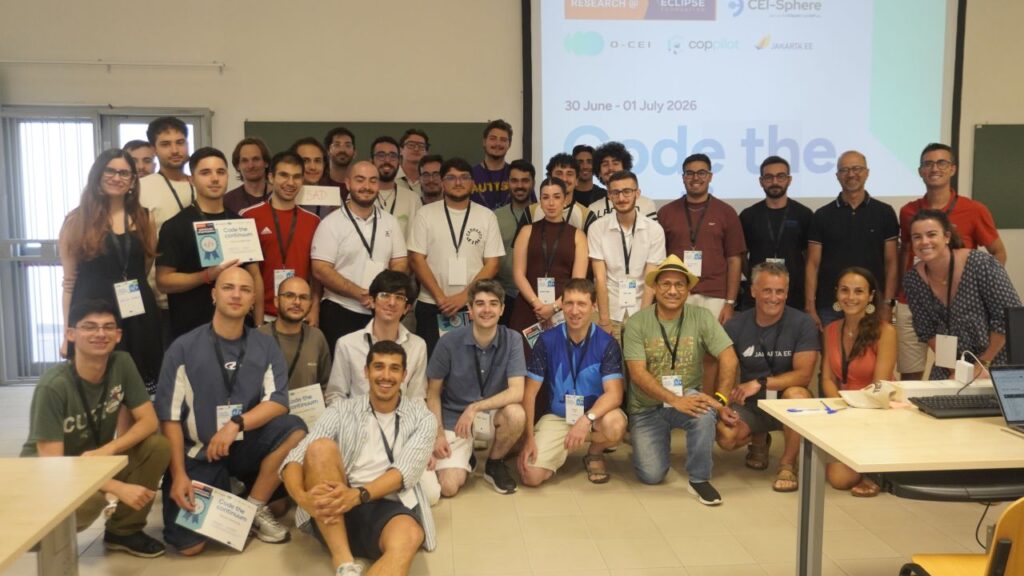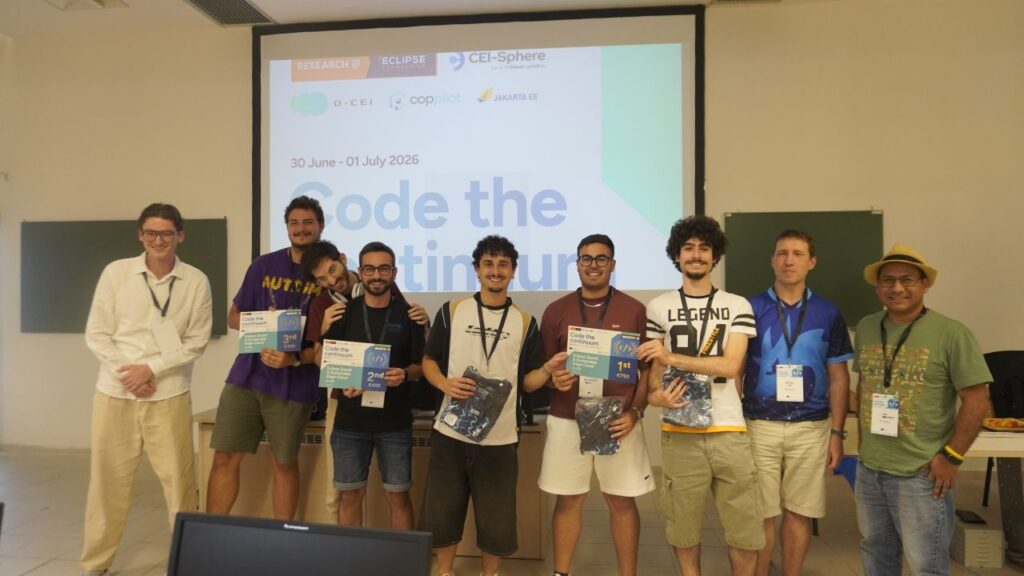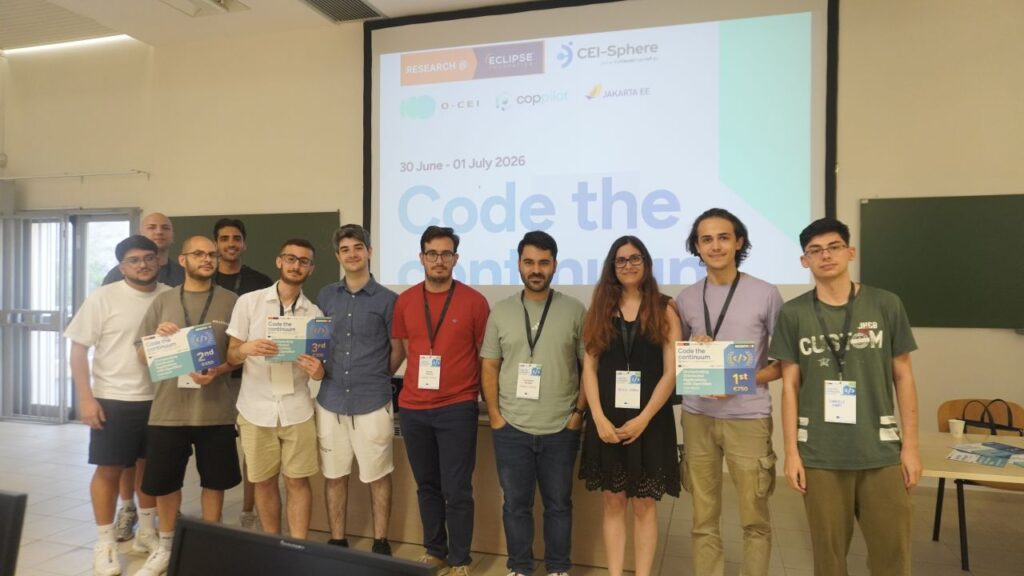

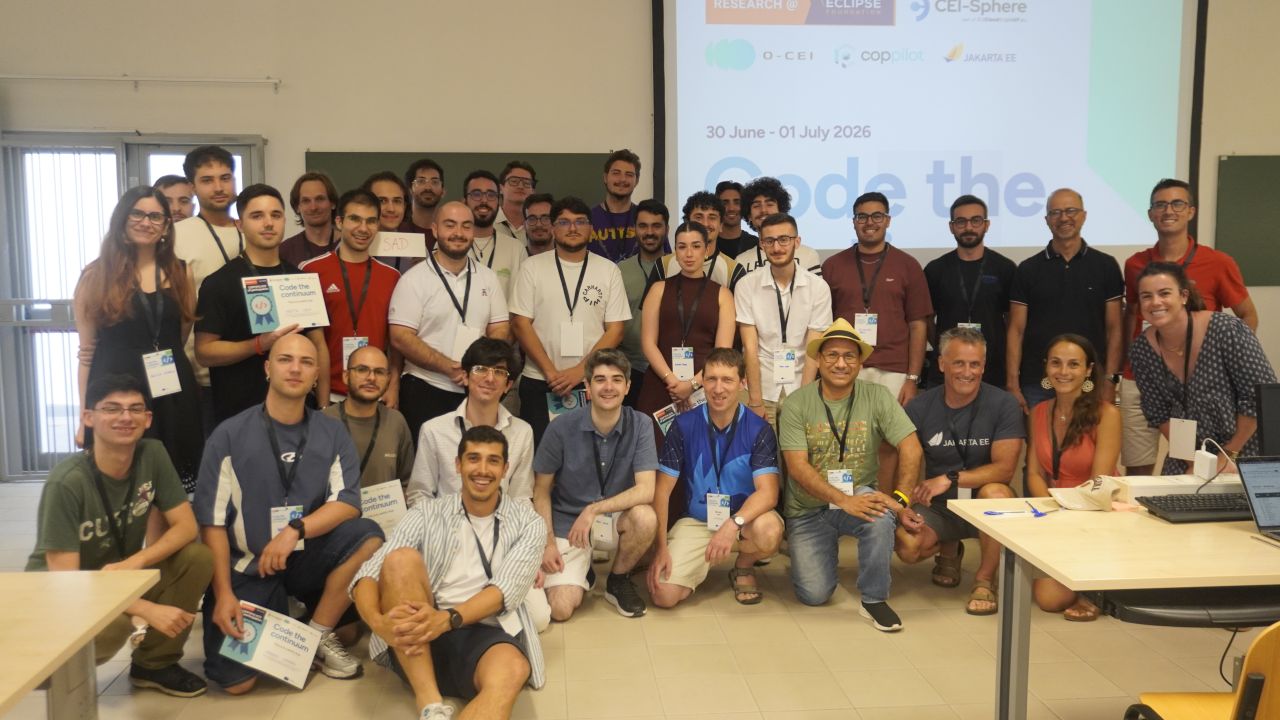
On 30 June – 1 July 2026, the Code the Continuum Hackathon brought together students, developers, researchers, innovators, and open-source enthusiasts at the University of Cagliari for two intensive days of collaboration, experimentation, and hands-on innovation. Co-organized by CEI-Sphere, O-CEI Horizon, COP-PILOT Horizon, and the Eclipse Foundation, the event created a unique space for participants to explore real-world challenges across the Cloud–Edge–IoT (CEI) continuum.
The hackathon was designed to bridge research, open-source technologies, and practical deployment scenarios, encouraging participants to develop working solutions that address some of the key technological challenges facing Europe’s digital ecosystem. Over the course of the event, teams worked closely with mentors from academia, industry, and European research projects, transforming ideas into functional prototypes while gaining valuable experience with cutting-edge technologies.
Three challenge tracks were proposed, each focusing on a different aspect of the Cloud–Edge–IoT continuum.
The COP-PILOT challenge explored the orchestration of distributed applications across edge and cloud environments using OpenSlice and Kubernetes. Participants experimented with deploying and managing containerised services across the computing continuum, highlighting the importance of interoperability and intelligent workload management.
The Eclipse Foundation challenge focused on the development of Jakarta EE applications enhanced with artificial intelligence and inspired by the Hourglass Model. Teams investigated how modern AI engineering techniques can be integrated into enterprise applications while leveraging open-source technologies and interoperable architectures.
For O-CEI Horizon, the spotlight was on Eclipse Zenoh & Sustainable Edge-Cloud, a challenge designed to demonstrate how intelligent data distribution can improve the efficiency of Cloud–Edge–IoT systems. Participants explored the capabilities of Eclipse Zenoh, an open-source communication protocol specifically designed for distributed environments, by comparing cloud-only deployments with edge-accelerated approaches.
Through practical experimentation, teams evaluated how processing data closer to where it is generated can reduce bandwidth consumption, optimise communication flows, and contribute to lower energy usage across distributed infrastructures. Using real demo applications and open-source repositories provided by experts from ZettaScale, participants deployed and adapted distributed scenarios, analysed message exchanges, and assessed the benefits of edge-enabled architectures. The challenge directly reflected O-CEI’s ambition to promote energy-efficient, interoperable, and scalable solutions across the Cloud–Edge–IoT continuum.
The quality of the work delivered throughout the hackathon was remarkable, with teams demonstrating both technical excellence and creative problem-solving. After two days of intense collaboration, the winners of the O-CEI challenge were:
- Cyber Guys – 1st place
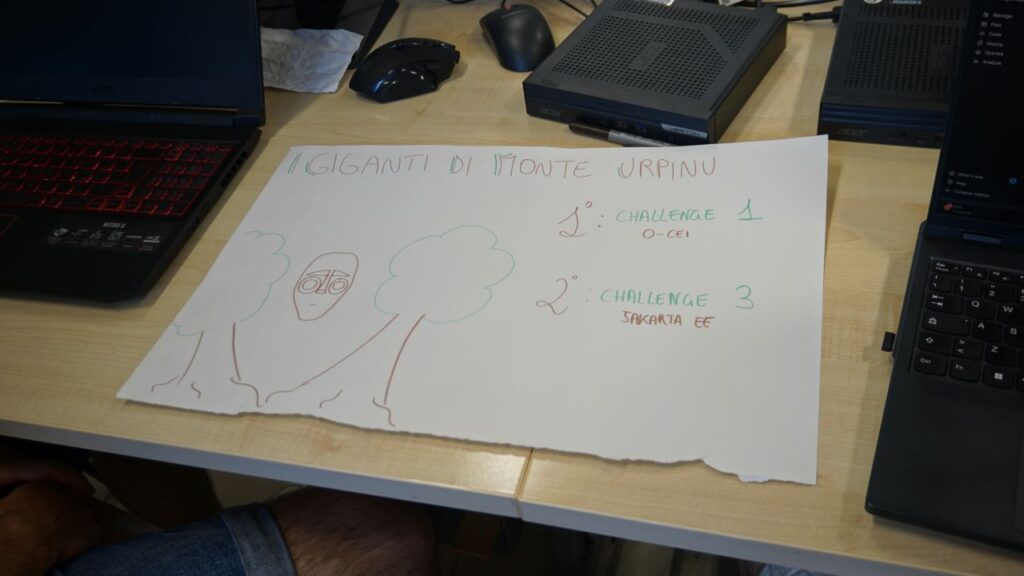
- Giganti di Monti Urpino – 2nd place
- Fork Yeah – 3rd place
Congratulations to all participating teams for their commitment, enthusiasm, and innovative spirit.
Beyond the competition itself, the event highlighted the importance of open-source collaboration and community building in accelerating the adoption of Cloud–Edge–IoT technologies. By bringing together researchers, developers, students, and industry experts around practical challenges, the hackathon demonstrated how shared experimentation can help transform research outcomes into deployable solutions and foster the next generation of digital innovation.
For O-CEI, the Code the Continuum Hackathon perfectly illustrated the project’s vision of building a more interoperable, sustainable, and open European Cloud-Edge-IoT ecosystem. As O-CEI continues to develop reusable blueprints, digital assets, and open technologies across its large-scale pilots, initiatives such as this hackathon play an essential role in engaging the wider community, promoting technology uptake, and strengthening the foundations of Europe’s digital sovereignty.