
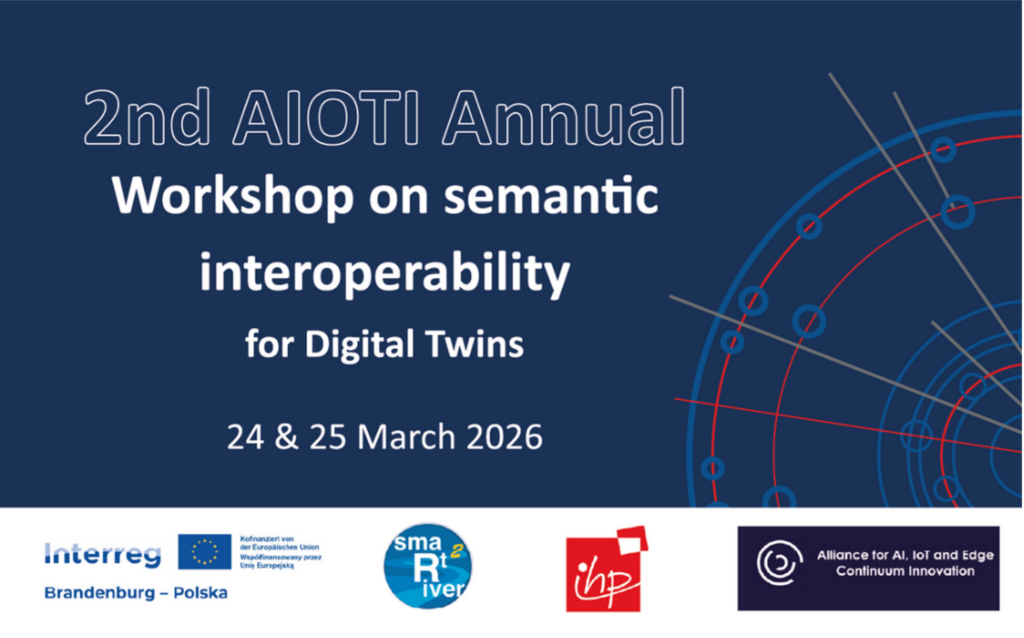
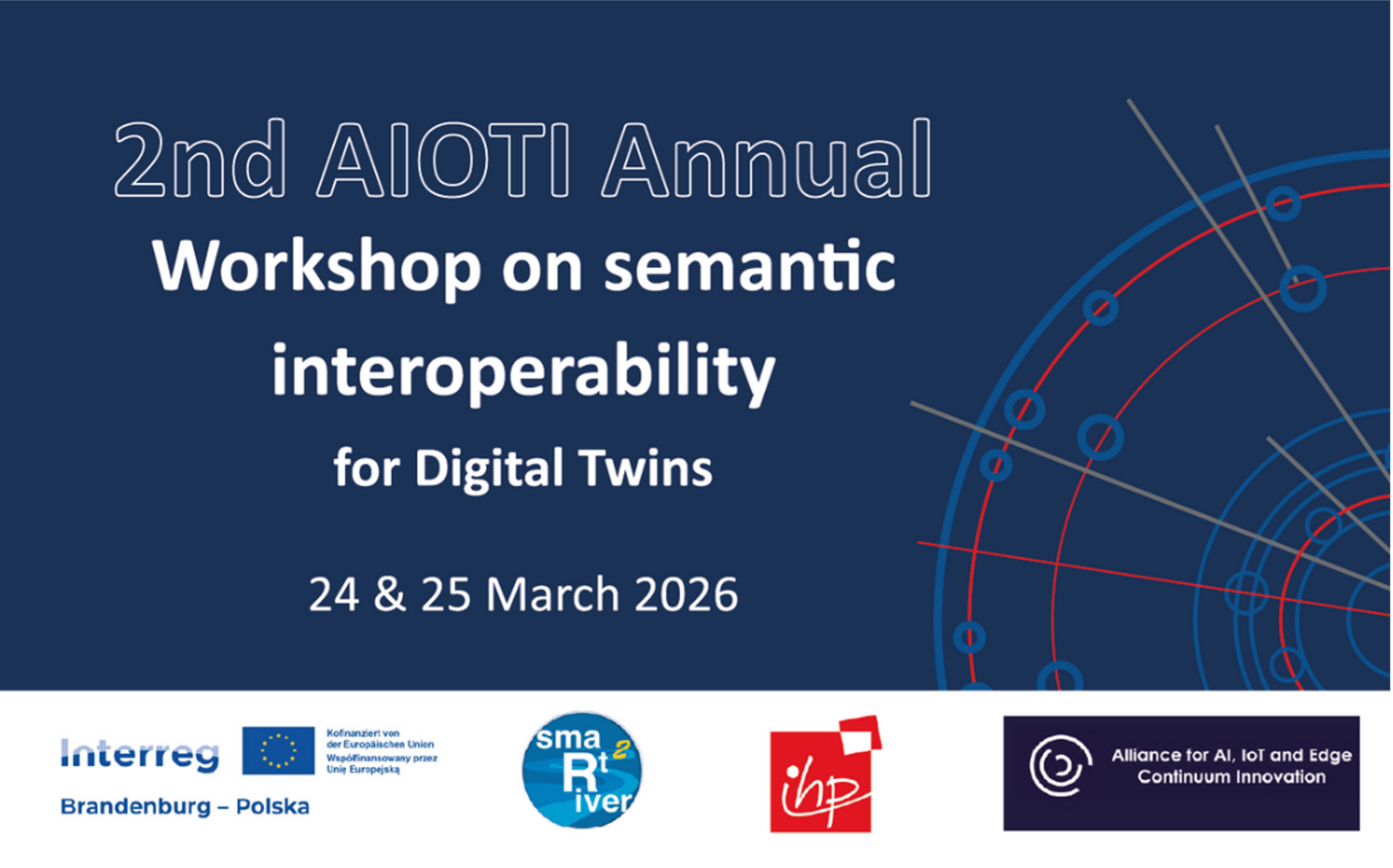
2nd AIOTI Workshop on Semantic Interoperability for Digital Twins on March 24 and 25th

Loading Events

EVENT

2nd AIOTI Workshop on Semantic Interoperability for Digital Twins on March 24 and 25th

DETAILS

Date & Time

March 24 - March 25

Event organiser

Event website

SUMMARY

Sessions to present and improve the “Manifesto for Reusable Ontologies” lead and facilitated by Trialog, with the participation of EDF

During this event, Antonio Kung will lead a session on the requirements and content of the “Manifesto for Reusable Ontologies” which is currently discussed within the semantic interoperability community, and is of high interest for both the CEI-Sphere and O-CEI projects.

This session will feature two introductory presentations by renowned European semantic interoperability experts and a panel discussion facilitated by Trialog. Here is the detailed agenda of this session :

  • Towards a FAIR-by-design ontology development framework, by María Poveda-Villalón (Universidad Politécnica de Madrid)
  • On the need for ontology hub interoperability, by Raúl Garcia-Castro (Universidad Politécnica de Madrid)
  • Panel discussion on the Manifesto for Reusable Ontologies :
    • Amelie Gyrard & Henon Mengistu Lamboro facilitators, Trialog
    • Members of the panel: Cornelis Bouter (TNO), Mahda Noura (Siemens), Raul Garcia (UPM), Martin Serrano (Insight Research Ireland Centre for Data Analytics), Zehor Hounas (EDF)

This panel session will bring together perspectives from academia, standardisation bodies, and industry. A high-level orientation on why we need such a manifesto will be discussed, and the viewpoint from the energy domain will also be provided.

This session will be followed by an interactive session (the next day) again facilitated by Trialog, and with the participation of EDF, named Towards the Manifesto for Reusable Ontologies. This breakout session will enable participants to make suggestions to help finalise the list of principles in order to reach an agreement. Relevant stakeholders from different communities will be invited to participate in the breakout session. Finally, EDF will also lead a technical session on Semantic Modelling of Digital Twins.
Advanced Microturbines

Can you briefly introduce your company and what you do?

Advanced Microturbines Srl is an Italian deep-tech SME specialised in the development of compact microturbine technologies for energy recovery and self-powered monitoring systems. The company designs and manufactures high-efficiency microturbines from 50 W to 50 kW capable of converting pressure drops in gas and water networks into electricity, enabling autonomous power supply for IoT sensors and digital infrastructure. Its solutions support the digitalisation and sustainability of energy and industrial systems by transforming unused pressure energy into a reliable source of power for remote monitoring applications. By combining microturbine technology with smart IoT systems, we deliver innovative solutions that support smart infrastructure, improve energy efficiency, and enable decentralised energy systems.

What challenge are you addressing under the O-CEI Horizon’s first Open Call, and how is your proposal relevant to the challenge?

Our proposal addresses the challenge of enabling transparent, secure, and real-time management of energy flows in decentralised energy systems, particularly in emerging smart microgrids. As renewable generation becomes increasingly distributed, local energy communities require reliable mechanisms to measure, validate, and share energy data between multiple actors. However, current infrastructures often rely on centralised systems, not distributed ones.

The ENTRUST solution tackles this challenge by developing an edge-validated blockchain platform for energy transactions. The system integrates IoT metering, edge computing, and blockchain notarisation to create a distributed architecture capable of securely validating energy data close to where it is generated. This approach enables real-time, low-latency processing while ensuring data integrity and transparency through blockchain mechanisms.

By combining edge processing with blockchain-based verification, the proposed platform allows microgrid participants, including households, local producers, and community operators, to securely record and validate energy exchanges. This contributes directly to the goals of the O-CEI Horizon’s Open Call by supporting decentralised, trustworthy, and scalable digital infrastructures for energy communities and smart grids.

What is the expected impact of your proposal?

The expected impact of the proposal is the development of a secure and transparent operational layer for decentralised energy systems, enabling more efficient management of renewable energy within local microgrids.

Through the integration of IoT metering, edge computing, and blockchain notarisation, the ENTRUST platform allows energy transactions and operational data to be securely recorded, validated, and shared in real time. This improves transparency and trust among microgrid participants while ensuring the integrity of energy data used for operational decisions and potential energy trading mechanisms.

The project will demonstrate the solution in the Krk Island pilot, showing how local communities can manage renewable energy generation and consumption more effectively. By enabling tamper-proof data validation and automated smart-contract processes, the platform supports fair and auditable energy exchanges between producers, consumers, and community operators.

Beyond the pilot, the modular and scalable architecture of ENTRUST allows the platform to be replicated in other energy communities and distributed energy systems across Europe. In this way, the project contributes to the broader objectives of the European energy transition, supporting the integration of renewable energy, strengthening local energy resilience, and enabling new models of transparent and decentralised energy management aligned with EU climate and energy policies.

Company website: www.microturbines.it