
NexusForum Talks: From Interoperability to Impact: Enabling Real-World Cloud-Edge Adoption in Europe

Loading Events

EVENT

NexusForum Talks: From Interoperability to Impact: Enabling Real-World Cloud-Edge Adoption in Europe

DETAILS

Date & Time

June 12

Event organiser

Event website

SUMMARY

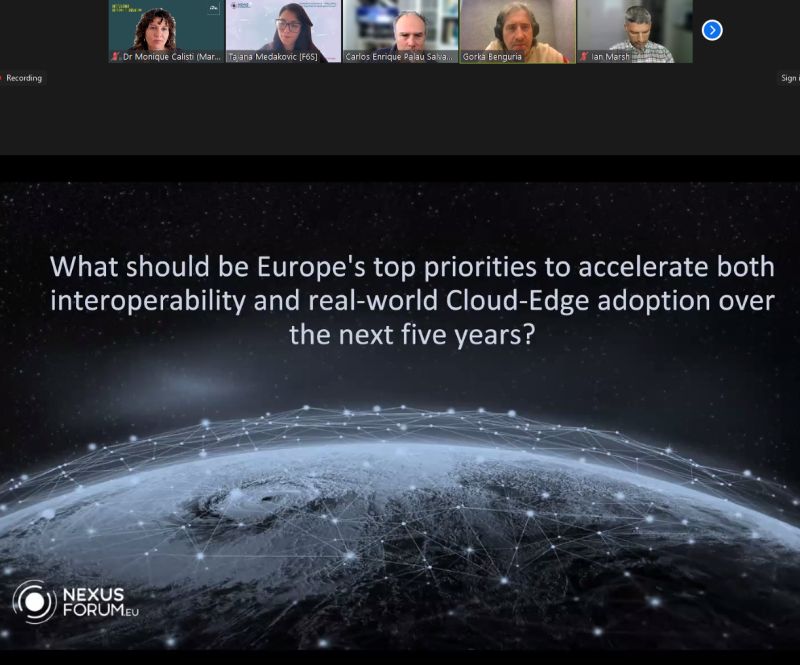
O-CEI Horizon participated in the NexusForum Talk “From Interoperability to Impact: Enabling Real-World Cloud-Edge Adoption in Europe”, a discussion focused on one of the key challenges facing the European Cloud–Edge–IoT ecosystem: how to move beyond successful pilots and transform innovation into scalable, interoperable, and operational solutions.

Representing O-CEI, Project Coordinator Prof. Carlos E. Palau (Universitat Politècnica de València) contributed to the discussion by sharing practical experience on simplifying the deployment and operation of Cloud–Edge–IoT solutions across distributed infrastructures. The discussion addressed some of the major barriers still limiting adoption, including fragmented ecosystems, legacy infrastructures, portability challenges, and the complexity of integrating interoperable AI and digital services across the continuum.

A recurring message throughout the session was that semantic interoperability remains a critical gap for the ecosystem. Participants also emphasized that ecosystem building is not only about technology but also about creating the conditions that enable adoption, collaboration, and long-term sustainability. Interoperability was highlighted as something that should be embedded by design from the outset, rather than addressed later through standardization efforts alone.

The conversation also explored how Europe can move from pilots to large-scale replication across multiple domains and, ultimately, from pilots to sustainable business models. In this context, the importance of demonstrating clear economic benefits was identified as a key factor in encouraging the uptake of sovereign European technologies.

O-CEI’s vision of combining a platform for designing and deploying reusable blueprints with a marketplace for publishing, discovering, and reusing interoperable digital assets was presented as a concrete approach to reducing fragmentation and accelerating real-world deployment.

The discussion reinforced a common ambition across the European Cloud–Edge–IoT community: not only to develop advanced technologies, but to make th
Advanced Microturbines

Can you briefly introduce your company and what you do?

Advanced Microturbines Srl is an Italian deep-tech SME specialised in the development of compact microturbine technologies for energy recovery and self-powered monitoring systems. The company designs and manufactures high-efficiency microturbines from 50 W to 50 kW capable of converting pressure drops in gas and water networks into electricity, enabling autonomous power supply for IoT sensors and digital infrastructure. Its solutions support the digitalisation and sustainability of energy and industrial systems by transforming unused pressure energy into a reliable source of power for remote monitoring applications. By combining microturbine technology with smart IoT systems, we deliver innovative solutions that support smart infrastructure, improve energy efficiency, and enable decentralised energy systems.

What challenge are you addressing under the O-CEI Horizon’s first Open Call, and how is your proposal relevant to the challenge?

Our proposal addresses the challenge of enabling transparent, secure, and real-time management of energy flows in decentralised energy systems, particularly in emerging smart microgrids. As renewable generation becomes increasingly distributed, local energy communities require reliable mechanisms to measure, validate, and share energy data between multiple actors. However, current infrastructures often rely on centralised systems, not distributed ones.

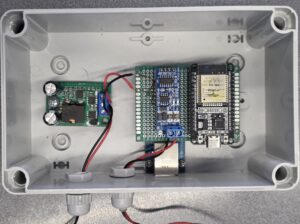
The ENTRUST solution tackles this challenge by developing an edge-validated blockchain platform for energy transactions. The system integrates IoT metering, edge computing, and blockchain notarisation to create a distributed architecture capable of securely validating energy data close to where it is generated. This approach enables real-time, low-latency processing while ensuring data integrity and transparency through blockchain mechanisms.

By combining edge processing with blockchain-based verification, the proposed platform allows microgrid participants, including households, local producers, and community operators, to securely record and validate energy exchanges. This contributes directly to the goals of the O-CEI Horizon’s Open Call by supporting decentralised, trustworthy, and scalable digital infrastructures for energy communities and smart grids.

What is the expected impact of your proposal?

The expected impact of the proposal is the development of a secure and transparent operational layer for decentralised energy systems, enabling more efficient management of renewable energy within local microgrids.

Through the integration of IoT metering, edge computing, and blockchain notarisation, the ENTRUST platform allows energy transactions and operational data to be securely recorded, validated, and shared in real time. This improves transparency and trust among microgrid participants while ensuring the integrity of energy data used for operational decisions and potential energy trading mechanisms.

The project will demonstrate the solution in the Krk Island pilot, showing how local communities can manage renewable energy generation and consumption more effectively. By enabling tamper-proof data validation and automated smart-contract processes, the platform supports fair and auditable energy exchanges between producers, consumers, and community operators.

Beyond the pilot, the modular and scalable architecture of ENTRUST allows the platform to be replicated in other energy communities and distributed energy systems across Europe. In this way, the project contributes to the broader objectives of the European energy transition, supporting the integration of renewable energy, strengthening local energy resilience, and enabling new models of transparent and decentralised energy management aligned with EU climate and energy policies.

Company website: www.microturbines.it