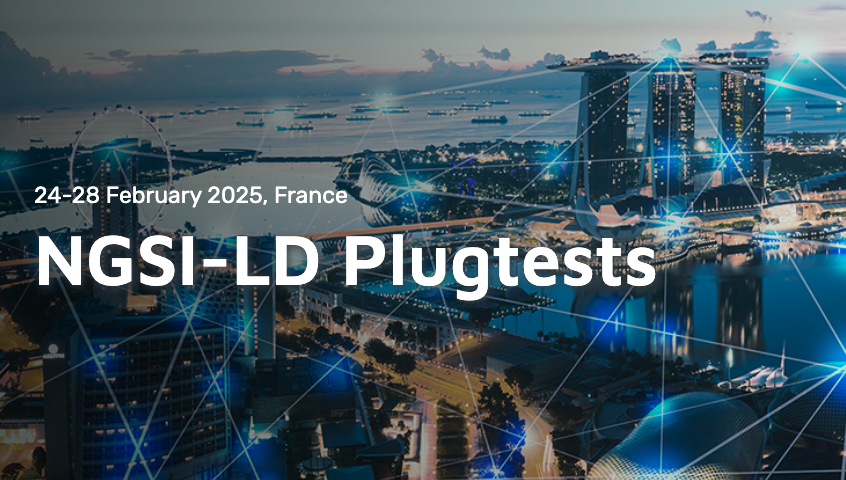
ETSI, with the support of the European Commission (EC) and the European Free Trade Association (EFTA), is organizing the NGSI-LD (Next Generation Service Interface - Linked Data) Plugtests™ event, which will be hosted by ETSI at Sophia Antipolis, France, from 24 to 28 February 2025. What are the objectives and scope of the NGSI-LD PLUGTESTS...
Antonio Kung presented the Hourglass Model and MIMs (Minimum Interoperability Mechanisms) for semantic interoperability. The Hourglass Model, proposed by CEI-Sphere and to be used by O-CEI, provides a framework for understanding ecosystems, architectures, and systems, emphasizing the role of Minimum Interoperability Mechanisms (MIMs) in enabling semantic interoperability. This approach highlights how diverse infrastructure provisions are...
On March 31st 2025, Mr. Rafael Vaño, from Universitat Politècnica de València (UPV) will participate in the MECC Workshop, co-organised with the ACM EuroSys conference. Mr. Vañó will present the results of a scientific work focused on the advances of edge and cloud-native innovative technologies and concepts. The article presented, titled "Federation of domains in the...
On April 2nd, 2025, Dr. Ignacio Lacalle (UPV) addressed a group of professors and PhD students fromthe Construction Informatics faculty at TU Dresden to elaborate on O-CEI innovations.The session, "Cloud-Edge Technology and Its Impact on Symbiotic Buildings", consisted of a pitchfocusing on how edge computing technologies are (and will be) a key enabler in achieving...
On April 2nd, during the “Trusted Data Exchanges: From Standards to Pilots in a Changing World” workshop, Martin Bauer (NEC Laboratories) will present the topic: “Introducing the role of NGSI-LD in enabling flexible and interoperable data exchanges across domains including handling of provenance information.” NGSI-LD standard (ETSI GS CIM 009) is one of the most...
Europe and Japan are advancing trusted data exchange through Data Spaces and Data Free Flow with Trust, respectively. Europe is establishing industry-wide Data Spaces in several key sectors (like Health, Mobility, and Energy), while Japan focuses on enabling secure data sharing across entities. O-CEI adopts Data Space technology as a foundation for its Cloud-Edge-IoT Continuum,...
The future of Energy Data Spaces is being shaped through collaboration, interoperability, and standardized approaches. As part of these efforts, the Trialog, our partner in O-CEI Horizon, actively participated in the OMEGA-X Standardization Workshop, a key event focused on strengthening connections with standardization committees working on Data Spaces and Smart Grids. The workshop provided a...
Can you briefly introduce your company and what you do?
Advanced Microturbines Srl is an Italian deep-tech SME specialised in the development of compact microturbine technologies for energy recovery and self-powered monitoring systems. The company designs and manufactures high-efficiency microturbines from 50 W to 50 kW capable of converting pressure drops in gas and water networks into electricity, enabling autonomous power supply for IoT sensors and digital infrastructure. Its solutions support the digitalisation and sustainability of energy and industrial systems by transforming unused pressure energy into a reliable source of power for remote monitoring applications. By combining microturbine technology with smart IoT systems, we deliver innovative solutions that support smart infrastructure, improve energy efficiency, and enable decentralised energy systems.
What challenge are you addressing under the O-CEI Horizon’s first Open Call, and how is your proposal relevant to the challenge?
Our proposal addresses the challenge of enabling transparent, secure, and real-time management of energy flows in decentralised energy systems, particularly in emerging smart microgrids. As renewable generation becomes increasingly distributed, local energy communities require reliable mechanisms to measure, validate, and share energy data between multiple actors. However, current infrastructures often rely on centralised systems, not distributed ones.
The ENTRUST solution tackles this challenge by developing an edge-validated blockchain platform for energy transactions. The system integrates IoT metering, edge computing, and blockchain notarisation to create a distributed architecture capable of securely validating energy data close to where it is generated. This approach enables real-time, low-latency processing while ensuring data integrity and transparency through blockchain mechanisms.
By combining edge processing with blockchain-based verification, the proposed platform allows microgrid participants, including households, local producers, and community operators, to securely record and validate energy exchanges. This contributes directly to the goals of the O-CEI Horizon’s Open Call by supporting decentralised, trustworthy, and scalable digital infrastructures for energy communities and smart grids.
What is the expected impact of your proposal?
The expected impact of the proposal is the development of a secure and transparent operational layer for decentralised energy systems, enabling more efficient management of renewable energy within local microgrids.
Through the integration of IoT metering, edge computing, and blockchain notarisation, the ENTRUST platform allows energy transactions and operational data to be securely recorded, validated, and shared in real time. This improves transparency and trust among microgrid participants while ensuring the integrity of energy data used for operational decisions and potential energy trading mechanisms.
The project will demonstrate the solution in the Krk Island pilot, showing how local communities can manage renewable energy generation and consumption more effectively. By enabling tamper-proof data validation and automated smart-contract processes, the platform supports fair and auditable energy exchanges between producers, consumers, and community operators.
Beyond the pilot, the modular and scalable architecture of ENTRUST allows the platform to be replicated in other energy communities and distributed energy systems across Europe. In this way, the project contributes to the broader objectives of the European energy transition, supporting the integration of renewable energy, strengthening local energy resilience, and enabling new models of transparent and decentralised energy management aligned with EU climate and energy policies.
Our website uses cookies. Some of these cookies are essential to the operation of the website itself and are used by default. Some other cookies are used to compile statistics on how you and others use our website. Such cookies are only placed and collected with your consent. For more information on how we use cookies, please refer to our cookie policy.