
As Europe accelerates its transition toward a decarbonized and digitalized energy system, the ability to coordinate distributed energy resources, storage systems, and prosumers through intelligent, connected infrastructures is becoming critical. Real-time data exchange, AI-based analytics, and edge-to-cloud orchestration are emerging as key enablers of this transformation, allowing flexibility, resilience, and efficiency across the energy value chain.
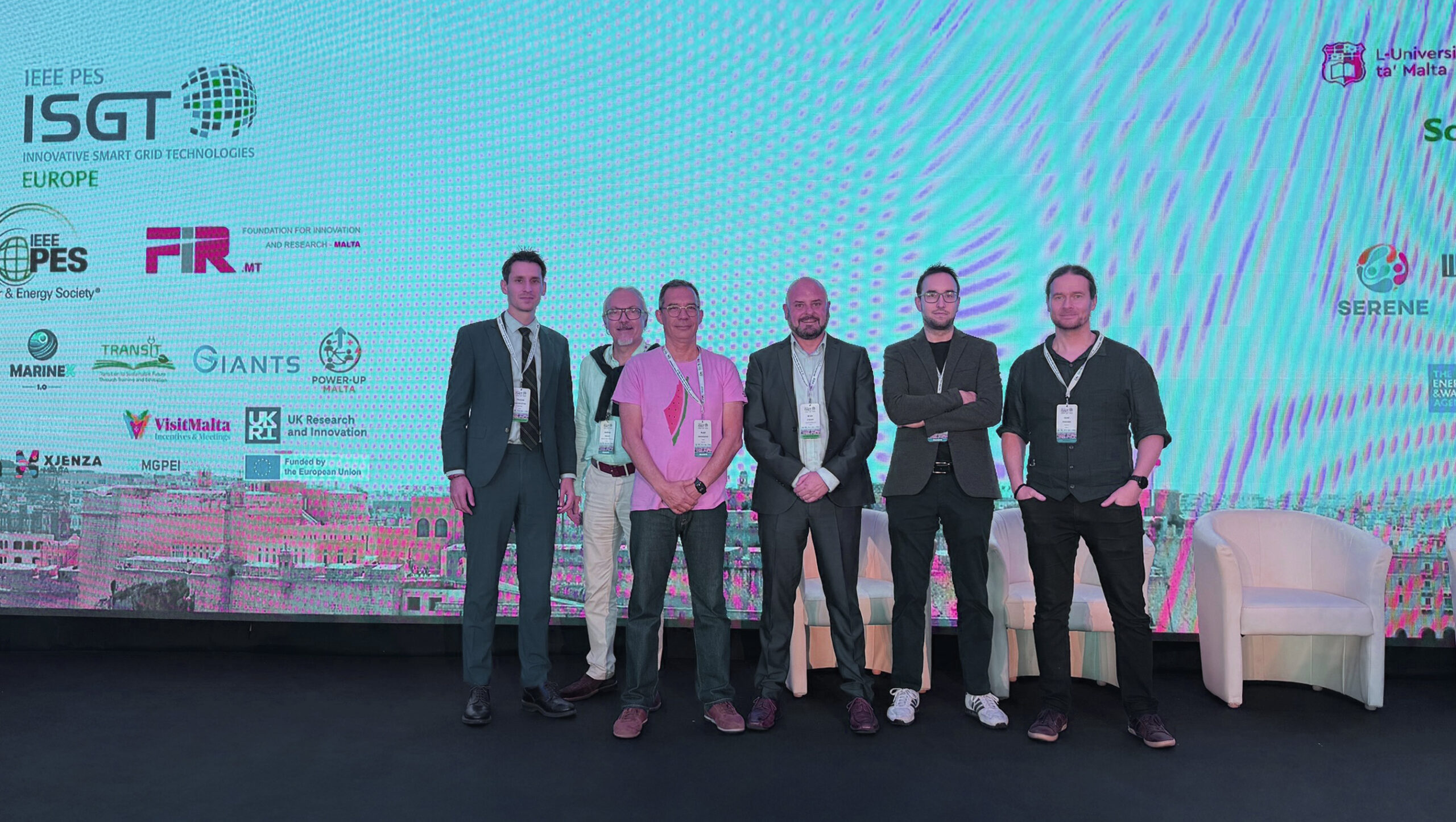
At this year’s IEEE ISGT Europe 2025, the special session “European Open IoT Edge/Cloud Continuum as Enabler for Energy Flexibility” brought these ideas into focus. Organized around the O-CEI Horizon project, the session showcased how open, interoperable, and secure digital infrastructures can act as Europe’s backbone for energy flexibility, bridging sectors and borders to support a cleaner, smarter energy future.
The discussion explored architecture blueprints, AI-driven coordination mechanisms, and cross-domain pilots demonstrating how the IoT-Edge-Cloud continuum can intelligently manage distributed energy systems. It also fostered dialogue between researchers, industry innovators, and policymakers, underlining Europe’s leadership in developing sovereign, sustainable, and scalable digital ecosystems for the energy transition.
The session was chaired by Prof. Andreas Kassler, from the Deggendorf Institute of Technology (DIT), who introduced the context of O-CEI and the overarching goals of the discussion.

O-CEI: From Concept to Real-World Validation
Dr. Alejandro Fornés, from the Universitat Politècnica de València (UPV), opened the presentations with an overview of the O-CEI project: its motivation, objectives, and methodology. He detailed how O-CEI builds on advanced IoT-Edge-Cloud enablers from previous European research to create a unified framework that can be applied across multiple domains, including energy, manufacturing, and mobility.
Dr. Fornés also introduced the project’s eight large-scale pilots, which validate O-CEI’s innovations in real-world environments, and announced the first Open Call, encouraging new partners to co-develop and integrate novel solutions within the O-CEI ecosystem. His presentation underscored the project’s mission to deliver open, interoperable, and intelligent digital infrastructures for Europe’s energy flexibility future.

Showcasing O-CEI Pilots: Smart Grids and Ports in Action
The session continued with presentations from partners leading several of O-CEI’s key pilots.
Mr. Thomas Gautier-Ottou, from CMA CGM, presented “Interoperability Between Power Plants and Consumers of All Scales”, focusing on Pilot 4 in Malta. He explained how the island’s limited energy generation capacity and reliance on imports create unique challenges for maintaining grid stability. Within this context, O-CEI seeks to enable interoperability between energy producers and consumers, using data gathering, predictive analytics, and demand management to prevent power peaks and outages—enhancing resilience and sustainability in the port’s energy ecosystem.

Building on this maritime context, still within the frame of the Pilot 4, Dr. Jussi Poikonen from Awake.AI presented “Predictive Modeling of Vessel Schedules, Port Operations, and Resulting Power Consumption for Flexible Port Operation.” His talk demonstrated how AI-driven prediction and simulation tools improve situational awareness and scheduling in port operations, ultimately reducing unnecessary energy consumption and supporting flexible energy use. The presentation underscored the role of data sharing and stakeholder collaboration as prerequisites for achieving long-term energy optimization in complex logistics environments.

AI, Flexibility, and Federated Learning for the Future Grid
The discussion then turned to the energy domain, with Dr. Brian O’Regan, Head of the Energy Informatics Group (EIG) at University College Cork (UCC), presenting outcomes from O-CEI’s Pilot 1. His presentation, “Electric Grid Performance Optimization upon RES Integration,” focused on how electricity and heat flexibility can unlock new value streams in grid management. Introducing the SHIFT Ontology, FLEXUS platform, and FlexSim tools, Dr. O’Regan described how these solutions enable peer-to-peer energy trading, flexibility orchestration, and real-time optimization across diverse use cases.

Finally, Prof. Nabil Abdennadher from the University of Applied Sciences Western Switzerland (HES-SO) concluded the session with “A Context-Aware AI-Based Edge-to-Cloud Continuum for Energy Flexibility.” Centred on O-CEI’s Pilot 8, his talk explored the application of federated learning and collaborative AI to manage energy across urban and rural buildings. He highlighted the importance of social acceptability by design, ensuring that digital energy services are trusted, human-centric, and beneficial for both consumers and the grid.

Europe’s Path Forward: Open, Interoperable, and Intelligent
This session reaffirmed O-CEI’s central role in driving Europe’s open edge-cloud continuum for the energy transition. Through its pilots, architectural frameworks, and AI-driven innovations, O-CEI is shaping how Europe can achieve true energy flexibility: via optimizing resources, enabling interoperability, and supporting sustainability at scale.
By connecting energy systems, data, and communities, O-CEI Horizon continues to lay the groundwork for a federated, intelligent, and sovereign digital infrastructure, a foundation for Europe’s cleaner, more resilient energy future.
IEEE Session: https://ieee-isgt-europe.org/european-open-iot-edge-cloud-continuum-as-enabler-for-energy-flexibility/